

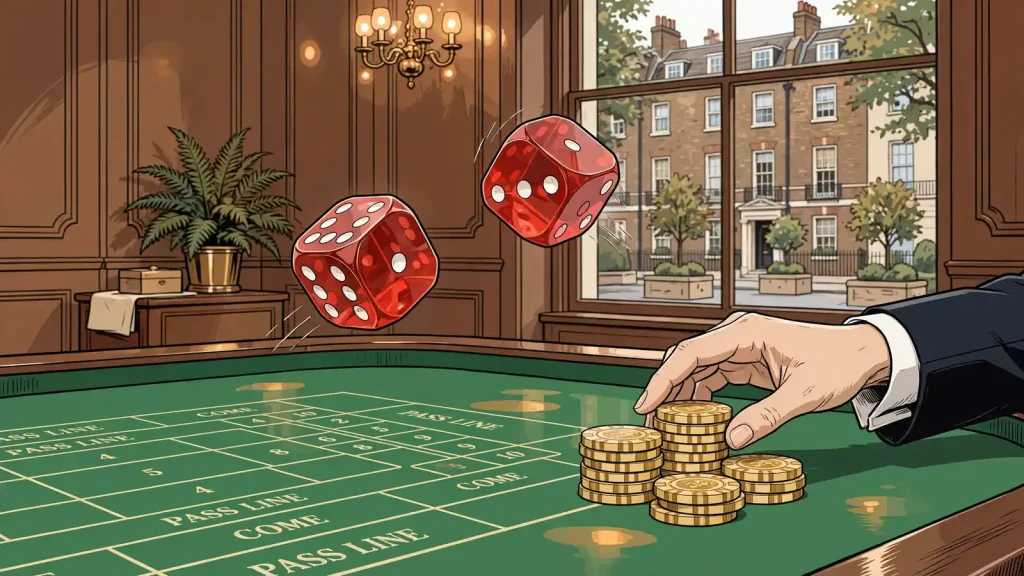
See how opening rolls, points and sevens shape a craps round, and learn how to assess tables and practise in free-play mode.
How Online Craps Bets Work
Craps is organised around a shared pair of dice and a sequence of rolls called a round. In an online casino craps game, the software produces the dice result, but the central logic is the same as at a physical table: bets are settled against the result of a roll or against what happens over the rest of the round. To understand what you stake, first separate the opening roll from the later rolls.
A round begins with the come-out roll. The player acting as shooter rolls the dice, and the result determines whether the round ends immediately or enters a continuing phase. If the opening result is a natural, the Pass Line bet wins; if it is a craps result, that bet loses. A different opening result establishes a point. The point remains active while the shooter keeps rolling, and the round continues until the point is rolled again or a seven appears.
That sequence is what makes a Pass Line bet a round-level wager rather than a prediction about just one roll. It wins if the opening roll produces a natural, or if the established point returns before seven. It loses if the opening roll is craps, or if seven appears before the point is made. After the point is set, the same dice result can therefore have a different consequence from the one it would have had on the come-out roll.
The Don’t Pass bet takes the opposite side of much of this sequence. It generally wins when the opening roll is craps, or when seven appears before the point is repeated. It loses on a natural or when the point is made first. The opening result can also produce a push for this bet, meaning the stake is returned rather than won or lost. The exact treatment of that result is part of the game’s rules, so read the on-screen rules before staking real money.
Slots & Providers: UK Casino Game Guides
Bets that depend on a point
Some wagers are placed after a point has been established. A Come bet behaves much like a new Pass Line bet: its own next roll acts as an opening result, and a qualifying number can become a separate target. If that target is made before seven, the bet wins; if seven arrives first, it loses. You can think of it as starting a smaller betting sequence while the main round continues.
A Don’t Come bet applies the opposing logic to a new sequence. It can win if seven appears before its target and lose if the target is rolled first, subject to the game’s rules for the initial result. These bets are distinct from a wager on the original point: each has its own progress and settlement condition. That distinction matters when several bets are active at once, because one roll may settle one wager while leaving another in place.
Odds bets are an additional stake associated with an existing Pass Line, Don’t Pass, Come or Don’t Come bet after its point or target has been established. They do not replace the original wager. Instead, they depend on the same target being resolved before seven. Whether an online game permits this added stake, and how it displays the combined position, depends on that game’s rules and interface.
Bets tied to a single roll
Not every craps wager lasts through a point sequence. A one-roll bet is settled by the next dice result. A player may, for instance, stake that a particular result will appear on that roll; if it does, the bet wins, and if it does not, the stake loses. Other wagers can cover a group of results or a particular combination. These are separate propositions, not part of the Pass Line sequence, and they can be settled even when the main round continues.
This difference in duration is useful when reading any real-money casino craps game. Before confirming a stake, identify what event settles it: the next roll, a specific number appearing, or the end of a point sequence. A bet that remains active can carry into later rolls, while a one-roll wager is cleared as soon as its result is known. The amount you stake is at risk according to that condition; it is not automatically returned merely because the main round is still underway.
Do
- Identify what event settles a bet before confirming a stake
- Track each bet by its specific condition
- Check the game rules to see if a wager is a one-roll or point-sequence bet
Don’t
- Assume a roll has one overall outcome for every stake
- Assume a bet automatically returns just because the main round continues
- Assume a wager is settled by the same rules as the Pass Line
How a stake moves through the round
A bet has a state as well as a value. It begins as an available wager, becomes active when accepted, and is then either paid, lost, returned or carried forward according to its settlement rule. For a Pass Line bet, for example, an opening roll may settle it at once, or establish a point and leave it active. The later roll that repeats the point or brings up seven then resolves it.
This is why two bets placed before the same roll can have different outcomes. One may be tied to that roll alone, while another depends on what happens across several rolls. A result can win one wager, lose another and leave a third unresolved. Track each bet by its condition rather than assuming that a roll has one overall outcome for every stake.
Craps can also allow bets that are not made before the come-out roll, while other wagers are restricted to particular stages. The rules shown by the game determine when each bet can be placed, removed or changed. Those timing rules affect what your money is exposed to: a wager placed after a point is known is not the same proposition as one placed before the opening roll.
For real-money play, the practical question is therefore not simply which number you are backing. It is what event activates the wager, what event settles it, and whether it stays on the table after a roll. Once those conditions are clear, the changing sequence of a craps round becomes easier to follow: the dice produce an event, each active bet checks that event against its own rule, and only then is the stake paid, lost, returned or left in play.
Best EGT Online Casinos UK: How Amatic Games Work
Finding Craps at a UK Online Casino
Finding an online craps table involves two separate checks: whether a casino actually provides the game, and whether the business taking your deposits is authorised to serve customers in Great Britain. A game appearing in a website’s promotional material does not answer either question on its own. The game may not be available in the casino’s current catalogue, and a supplier named beside it is not necessarily the company responsible for your account.
The operator is the business you play with
A consumer-facing casino lets you open an account, deposit funds, place bets and request withdrawals. The operator running that service is responsible for those activities. A game supplier, by contrast, provides software that an operator may make available through its site or app. The supplier is not the casino simply because its name appears on a game screen or in a catalogue.
This distinction matters when you search for a craps casino in the UK. Check which company operates the website and would hold your account before treating the game as available to you. If a page describes a software provider but does not identify the operator offering the game, it has not established where you would play or who would handle your funds.
The operator and the game can also be discussed separately without implying that one guarantees the other. A licensed casino may offer many games, but that does not mean it offers craps. Conversely, a page displaying a craps title does not establish that the site is authorised to accept real-money bets from customers in Great Britain.
What a UKGC licence covers
The UK Gambling Commission, commonly called the UKGC, regulates commercial gambling in Great Britain, including remote gambling offered to consumers there. Its jurisdiction does not depend on the location of the equipment running a casino’s website or game. A business serving the British market must therefore be considered by reference to the operator and its authorisation, not merely the country where the company, server or software supplier is based.
The UK Gambling Commission (UKGC) regulates commercial gambling in Great Britain. A business must hold an appropriate operating licence to serve the British market, regardless of where its servers or software suppliers are located.
The Commission issues operating licences to businesses. It also issues personal licences to individuals in relevant gambling roles, but a person’s licence is not a substitute for the business’s operating licence. When checking a casino, the relevant question is whether the company providing the remote gambling service holds the appropriate operating authorisation.
A provider or software company may have a role in making a game available, but its status does not transfer to the casino using its software. Likewise, an operator’s licence does not mean that every game mentioned in an advert is currently available. Treat licensing and game availability as distinct facts: one concerns the authority to provide gambling, the other concerns whether the particular table is offered through that operator.
Check the business before depositing
Start with the casino’s own legal or licensing information and identify the operator by its registered business name. Then check that business against the UKGC’s public register, matching the name and licence details rather than relying on a logo or a general statement that the site is “regulated”. A brand name displayed to customers may differ from the legal name of the company holding the licence, so the relationship between the brand and the licensed business should be clear.
If you cannot identify the operator, cannot match it to a current UKGC operating licence, or find that the licence belongs to a different business, do not treat the site as a UK-licensed casino. A licence held by a software supplier, a sister company or another brand does not by itself authorise the operator handling your account. The check is about the business offering gambling to you.
Only after identifying the operator should you confirm that craps is actually offered through its casino. Look for the game in the operator’s own catalogue or search function, and check that the listing leads into the casino rather than to an unrelated information page. Availability can depend on the operator’s current catalogue, so a third-party mention or an old promotion is not proof that you can open the table now.
Quickspin Casinos in the UK: Games and Checks
Why location claims are not enough
A website may be accessible from Great Britain while its operator is not authorised to serve British customers. Access to a page, a British-facing currency display or a game that loads in your browser does not establish UKGC oversight. The relevant issue is whether the business accepts remote gambling from customers in Great Britain under the required UKGC operating licence.
The same principle applies when a casino advertises a game as “UK” or presents itself as a UK casino. Those words are not a substitute for checking the company behind the service. The UKGC is the sole regulator for commercial gambling in Great Britain, so another regulator’s approval does not replace the authorisation required for a casino serving this market.
A sound route is therefore simple: identify the operator, verify its UKGC operating licence, and then confirm craps in that operator’s own catalogue. These checks establish who is responsible for the gambling service and whether the game is offered there. They do not require you to assume that every licensed casino has craps, or that every site displaying craps is licensed for the British market.
Our top casino picks for the UK
- Revery PlayBonus: 100% up to€1,000+ 100 FS · Payout speed: 1-3 business days
- SpinFormulaBonus: 550% Up To £15,000 + 550 FS · Payout speed: 1-3 business days
- BritsinoBonus: Welcome Package – Get your £2,200 + 2,000 FS · Payout speed: 1-3 business days
- ZombillionBonus: Welcome Pack 250% up to £4000 + 200 FS · Payout speed: 1-3 business days
- NightLuckBonus: Welcome Pack + 805% Up To 6400€ + 280 FS · Payout speed: 1-3 business days
- BeOnBetBonus: 100% up to €500 + 100 FS · Payout speed: 1-3 business days
- WinBeastBonus: €5000 + 500 FS + €650 Freebet · Payout speed: 1-3 business days
How to Assess a Casino’s Craps Offer
A casino’s craps offer is more than a game tile in its lobby. You need to establish that the title is playable through that operator, understand the terms attached to real-money play, and know which protections apply to your account. Those checks help distinguish a usable offer from one that merely looks relevant.
Confirm the game is actually available
Start with the casino’s own games lobby. Search for craps, then open the game rather than relying on a promotional image or a general statement that the site has table games. Check whether the game loads, whether it offers real-money play, and whether access depends on signing in or meeting an account requirement.
Availability can vary between operators, even when they draw from the same software suppliers. A game supplier provides software to casinos; it does not necessarily run a consumer-facing casino or accept your bets. In the UK, Amatic Industries is a software supplier, not a place to open a player account. The operator controls the lobby, account, deposits, payouts and customer support.
Best Betsoft Online Casinos UK: Games and Access
If a casino’s site lists a supplier, treat that as a clue about the software, not proof that a particular craps game is available. Look for the game itself in the operator’s current lobby, and check its rules and information panel once it opens. If the title is absent, unavailable in your location or restricted to another mode, the offer may not meet your needs.
Check what the game provides
Before staking money, inspect the game’s own help screen. It should explain how to place and remove bets, when bets are accepted, how the roll affects them and how winnings or returned stakes are shown. The table interface should make it possible to identify the selected bet and stake before you confirm it.
Check whether the casino offers the format you want, such as a computer-run game or a live-dealer table. The label alone is not enough: confirm what appears when you open the game. Also review the available stake controls and any table restrictions. The point is to see whether you can use the game as intended, not to infer its features from a casino’s general claims.
Look for the game’s rules before play, especially if the layout uses abbreviated labels or unfamiliar bet names. If the rules are difficult to find, unclear, or do not match the controls shown in the game, pause rather than guessing. A bet can be accepted by the interface while still behaving differently from what you assumed.
Read the operator’s terms
The casino operator, rather than the software supplier, is responsible for the terms governing your account. Read the relevant sections on deposits, withdrawals, bonuses and account restrictions before you make a first deposit. Confirm how the operator handles a disputed transaction and where its customer-support contact options are shown.
If you plan to use a bonus, check whether craps is eligible and whether any bonus funds can be used on the game. Bonus terms may exclude particular games or restrict how funds can be staked. The UK Gambling Commission caps wagering requirements on bonus funds at ten times the bonus amount. An offer can still have other conditions, so read the full terms rather than relying on a headline promotion.
Amatic Online Casinos UK: Games and Access
Do not assume that a promotion applies to every game or that a displayed balance is immediately withdrawable. Check when winnings become cash, whether a playthrough condition applies, and what happens if you cancel the bonus. If those conditions are not clear, ask the operator before opting in.
Assess account protections and support
A suitable offer should sit within a properly managed account, not just provide access to a game. UKGC-licensed online operators must prompt you to set a financial limit before your first deposit, and a reduction to that limit must take effect immediately. Consider setting a limit that reflects what you can afford to lose, and use the account controls to keep your spending within it.
GamStop is mandatory for UKGC-licensed online operators. If you have registered with GamStop, you should not use another operator account to get around that exclusion. You can also check what tools the casino provides for reviewing activity or restricting your account, and how to contact support if a control does not work as expected.
Amatic Online Casinos in the UK: Games and Licensing
Assess whether the help pages explain how to report a problem with a game, payment or account. The operator handles customer support and payouts; the game supplier does not replace that route. Keep the operator’s terms and the game’s rules available while you play, so you can compare what happened with the stated conditions.
Make the decision from what you can verify
A practical assessment comes down to evidence you can see: the craps game opens at the casino, its rules match the interface, the operator’s terms explain how funds and bonuses are handled, and account protections and support are accessible. If any part remains unclear, do not treat a banner, supplier name or general claim about table games as confirmation. Check directly with the operator before depositing.
Reading the Craps Table and Placing Bets
A craps table is a map of betting positions. Each marked area corresponds to a particular wager, and the same roll can affect bets in different areas in different ways. Before you select a chip, identify the area, check whether the table is in the come-out phase or a point phase, and read the game’s displayed rules for that wager. That sequence helps prevent a common interface error: choosing a bet because its label looks familiar without noticing that it is not available at the current stage.
Amatic Games at UK Online Casinos: How They Work
Find the main areas
The largest area is usually the Pass Line, which runs along the shooter’s side of the layout. The Don’t Pass area is beside it. These are the main choices for a player who wants a wager to follow either the shooter’s Pass Line position or its opposite. Other parts of the layout show point numbers and additional betting areas.
You do not need to memorise the whole table before using it. Start by locating the Pass Line and Don’t Pass positions, then find the marked numbers and any areas labelled Come or Don’t Come. The labels matter more than colour or position: layouts can vary between games, while a label tells you which wager you are selecting. If an area is unclear, open the game’s rules or help panel before placing a stake.
A point number shown on the table is a status marker as well as a betting location. Once a point has been established, the layout may highlight it or use a puck indicator to show that the game is in the point phase. The puck’s position helps you distinguish that phase from the come-out phase. Check the indicator before placing a wager whose availability or meaning depends on the phase.
Select and confirm a wager
Online tables commonly let you choose a chip value and then click or tap a betting area. Some interfaces also let you drag a chip, use controls to adjust the amount, or repeat a previous wager. These are interface functions, not changes to the wager itself. Before confirming, check the amount displayed on the selected area and ensure the chip is on the intended label.
A reliable placement sequence is:
- Check the current phase and the puck indicator.
- Select a chip value that matches the amount you intend to stake.
- Tap or click the centre of the chosen betting area.
- Read the displayed wager amount and confirm that it is in the correct position.
- Use the table’s confirmation control, if one is shown, before the roll begins.
The final check is important because adjacent betting areas can be close together on a small screen. A chip placed on a neighbouring label may create a different wager, even if the difference is hard to see. If the interface offers an undo or clear control before betting closes, use it to correct a misplaced chip rather than assuming the game will interpret your intention.
The controls for removing or changing a wager depend on the game. Look for instructions shown beside the table, in a menu, or in the help panel. In some interfaces a chip can be selected and removed directly; in others, a dedicated control is used. Do not rely on a control from another game, since the same action may behave differently across interfaces.
Follow the table’s phase markers
At the start of a round, the table is in the come-out phase. The displayed layout and game state indicate which wagers can be placed at that moment. If the roll establishes a point, the table changes to the point phase, typically making the point marker visible. Bets that depend on a particular phase may then become available or change how they are resolved. Follow the game’s prompts rather than trying to place every kind of wager at once.
Amatic Online Casinos UK: Games and Availability
The Come and Don’t Come areas are separate from the Pass Line and Don’t Pass areas. They provide positions for wagers made during the point phase, and their placement is tied to a later roll. When one of these wagers is active, the game may move its marker from the central Come area to a numbered box. That movement records the number associated with the wager. Check the new position after the roll so you can see which number the game has attached to it.
Other labelled areas may allow wagers on particular outcomes or combinations. Their location on the layout does not, by itself, explain when they can be placed, how long they remain active, or when they are settled. Read the wager description in the game rules and check whether the table provides a separate control for removing it. This is especially useful for bets that are not confined to a single roll.
Watch how the game records your wager
After a roll, the table updates the point marker, wager markers and balance display. Those changes show what the game has recorded, but they do not replace the rules for each bet. Look for three things: whether the wager remains on the layout, whether its marker has moved, and whether the balance has changed. A wager that has been settled may disappear or be cleared; one that remains active may stay in place for a later roll.
Checking Settlement
After a roll, look for three things: whether the wager remains on the layout, whether its marker has moved, and whether the balance has changed. This helps confirm if a bet was settled or remains active.
If the balance display changes, compare it with the wager history or round summary where available. The history can show the amount staked, the result recorded and the amount returned. This gives you a way to check the settlement rather than inferring it from a chip disappearing. If a result is not clear, pause before placing another wager and consult the game’s help or recorded round details.
A useful table habit is to separate placement from review. Place only the wager you intend to make, confirm its location and amount, then watch the roll and inspect the resulting layout. Avoid adding chips while you are still working out what happened to an earlier bet. This keeps the table state readable and reduces the chance of carrying an unintended wager into the next roll.
Use the layout, not guesswork
The table is designed to show where a wager sits and how the game tracks it, but the layout alone may not answer every question about timing or settlement. Treat labels, phase markers and game instructions as one system: the label identifies the bet, the phase determines when it can be placed, and the result display shows what happened to it.
If you are unsure whether a chip is on the Pass Line, a point-number box or another area, do not proceed to the roll. Remove or correct it using the game’s controls, then verify the amount and position again. This simple check is more useful than trying to remember a table from another casino game, because online craps interfaces can present the same underlying betting concepts with different layouts and controls.
Practising Craps in Free-Play Mode
A free-play craps game lets you interact with a simulated table without staking money. Use it to learn how the controls respond, where your selected bets appear and how the game displays a roll’s result. Treat it as interface practice, not as evidence that real-money play will feel identical: table designs and controls can differ between games.
Amatic Slots at UK Casinos: Games and Access
What to practise
Start by following a round without trying to make many decisions at once. Find the area where bets are selected, place a practice bet, and check how the interface shows that it is active. Then follow the roll and observe whether the display marks the bet as continuing, winning or losing. The aim is to connect each on-screen change to an action or result.
Next, vary one decision at a time. For instance, remove or change a selection before the roll, then see how the table reflects the edit. If the game has a control for repeating a previous set of bets, inspect what it would repeat before using it. A repeat control may copy several selections, so confirm the displayed layout rather than assuming it applies only to the most recent choice.
Free play can also help you learn the timing of the interface. Notice when betting is open, when it closes and when the next decision becomes available. That makes it easier to avoid pressing a control after the game has locked the table for a roll.
Bubble-style craps
Bubble craps presents a digital version of the game, often with dice shown inside a bubble or another animated display. It is still a software-controlled game rather than a live dealer handling physical dice. In free-play mode, the same visual format can help you practise reading the screen and locating controls without risking a stake.
Focus on what the display communicates: which bets are selected, whether betting is open, and how the result is applied to those selections. Animations can make a roll easier to follow, but they do not change the need to understand what you have selected before play proceeds.
Attention Practice mode removes financial consequences and cannot predict how you will react to real stakes. Do not use free-play results to establish patterns for real-money gambling.
Know what free play does not show
Practice mode removes the financial consequence of a decision. It therefore cannot show how you will respond when a real stake is involved, and it should not be used to infer that a sequence of favourable results predicts what comes next. Each roll is a new game event; a run of results in a demonstration does not establish a pattern to rely on.
Free-play access may also use a different table or interface from the real-money version. Before treating practice as preparation for another format, compare the available controls and table layout. If a feature is absent or behaves differently, learn it from the game’s own instructions rather than guessing.
The useful outcome is familiarity: you can identify the controls, understand the table’s feedback and pause before confirming a selection. That reduces interface confusion, while leaving the decision about whether to stake money separate from practice.
A First Craps Session: From Joining a Table to the First Roll
Start by opening the craps game and choosing a table. Before you enter, check whether it is a practice table or a real-money table; the interface may look similar, but the balance and consequences of a bet differ. If you are using real money, make sure you are on a UKGC-licensed casino site and have completed its account checks.
When the table loads, pause before staking anything. Find the displayed balance, the chip or stake selector, the betting area, and the control that confirms or clears a selection. Check how the interface shows the current stage of play and whether betting is open. These cues tell you whether a selection is still editable or has been accepted for the coming roll.
Amatic Games at UK Online Casinos: What to Know
For a first attempt, choose one straightforward bet and select a stake you understand. Click or tap the relevant position on the layout, then check that the selected amount appears where you intended. If it is wrong, remove or change it before confirming. Do not assume a chip has been placed just because you tapped the table: look for the game’s confirmation that the wager is active.
Once betting closes, follow the roll rather than trying to act on a control that is no longer available. The game displays the dice result and updates the table to show whether the wager remains active, has won, or has been settled. If the round continues, wait for the next betting opportunity before changing your position. If it ends, review the balance and the settlement before placing anything else.
To learn how to play craps at a casino, keep the first session narrow: observe the stage of the round, make one deliberate selection, and trace what the result does to that selection. This makes it easier to tell which controls affect your bet and which simply display the game state. Never increase a stake to recover a loss; stop if the session no longer fits the limit you set.
Live Craps, Crapless Tables and Crypto Claims
A live-dealer label, a crapless table and a cryptocurrency payment option are separate claims. One does not establish the others, and none by itself shows that a service is authorised to take bets from people in Great Britain.
For a live table, check whether the game is actually dealt by a person or generated by software, and identify the operator named in the account and payment terms. Amatic’s online catalogue includes RNG table games but no live-dealer games, so an Amatic-branded title should not be treated as a live craps stream. A site’s general live-casino section may also contain games unrelated to craps.
Verify Licensing Do not assume a site is UK-authorised based on a British-facing page or crypto options. Only play with an operator that holds a valid UKGC operating licence.
A crapless table changes the game’s layout and rules; the label alone does not tell you which version is offered. Read the on-screen rules and paytable before staking money. Confirm which numbers can be established as points and how the table settles bets, rather than assuming that a familiar craps interface uses standard rules.
Treat crypto claims as a payment detail, not proof of UK access. A specialist review reported no confirmed UKGC-licensed operator accepting cryptocurrency for Amatic play. That is a time-sensitive report, not a guarantee about every operator or a permanent statement about the market. Check the operator’s current payment terms and its UKGC status independently.
Casinos offering Amatic games under offshore licences, including Winstler and MrJones, operate outside the UK regulatory framework. A foreign licence does not replace the UKGC licence required for remote gambling offered to consumers in Great Britain. Do not infer UK authorisation from a British-facing page, a familiar game title, or an advertised crypto wallet. The relevant question is whether the business taking your deposit and paying any winnings holds the appropriate UKGC operating licence.
What the Craps House Edge Tells You
The house edge describes the casino’s mathematical advantage over repeated play on a particular bet. It is a long-run measure: it does not predict the result of your next roll, nor does it mean the casino wins every time. A player can win or lose in any individual round, while the edge describes how the bet behaves across many repetitions.
When comparing craps bets, check the house edge for each specific bet rather than treating the game as having one universal figure. Different bets use different rules and settlement conditions, so their long-run costs can differ. A figure for one wager does not automatically apply to another, even when both appear on the same table.
The edge is useful for comparing the mathematical cost of otherwise similar choices, but it is not a complete measure of how a bet feels to play. It does not tell you how often a bet wins, how large a particular payout may be, or how long your balance might last. Those are separate features, and a lower edge does not guarantee a winning session.
Best Wazdan Casinos UK: Amatic Games Explained
Before relying on a figure, make sure it applies to the exact wager and table rules you are considering. If the rules or payout terms differ, the calculation may differ too. Treat the house edge as a comparison tool for long-run expected cost, not as a forecast or a promise about your results.
Understanding Your Chances of Winning a Craps Round
The chance of winning a craps bet and the house edge describe different things. A bet’s chance of winning tells you how often its specified outcome is expected to occur across repeated plays. The house edge describes the casino’s long-run mathematical advantage on that bet. Neither measure, on its own, tells you what will happen on your next roll.
A bet can win frequently yet still have a house edge. The reason is that the amount paid when it wins, the amount lost when it does not, and the likelihood of each result all affect its long-run value. A less frequent winning outcome may pay more, but that does not automatically make the bet favourable. To assess the bet, you need its rules and payout as well as the probability of each outcome.
The phrase “winning a round” can also mean different things. You might mean winning one particular wager, ending a sequence of rolls ahead, or leaving the table with more money than you started with. Those are not interchangeable measures. A wager can settle as a win while your overall session is down, or settle as a loss while other wagers leave you ahead.
When comparing bets, first define what counts as a win and over what unit: one wager, a sequence, or the session. Then consider the payout and the house edge separately. A single result is uncertain; the edge is a long-run measure, not a prediction of an individual outcome.
Can I play Amatic slots for free in demo mode at UK casinos?
You can play Amatic games in a mobile browser, but whether a UK casino offers a free demo depends on that operator’s game options.
What is Amatic Industries and when was it founded?
Amatic Industries GmbH is an Austrian business-to-business gaming software supplier, founded in 1993. It supplies games to UK-licensed casinos but does not run consumer-facing casinos.
What is the new UK slots stake limit and how does it affect Amatic games?
The online slots stake limit is £5 per game cycle for players aged 25 and over, and £2 for players aged 18 to 24. These limits apply to Amatic slots offered by UK-licensed operators.
Are Amatic casinos on GamStop?
Amatic itself does not operate casinos, but GamStop has been mandatory for all Great Britain-licensed online operators since 31 March 2020. Check that the casino offering an Amatic game is UK-licensed.
Do Amatic casinos accept PayPal and other e-wallets?
Amatic does not handle deposits; the casino operator handles payment methods. Check the operator’s cashier to see whether PayPal or another e-wallet is accepted.