

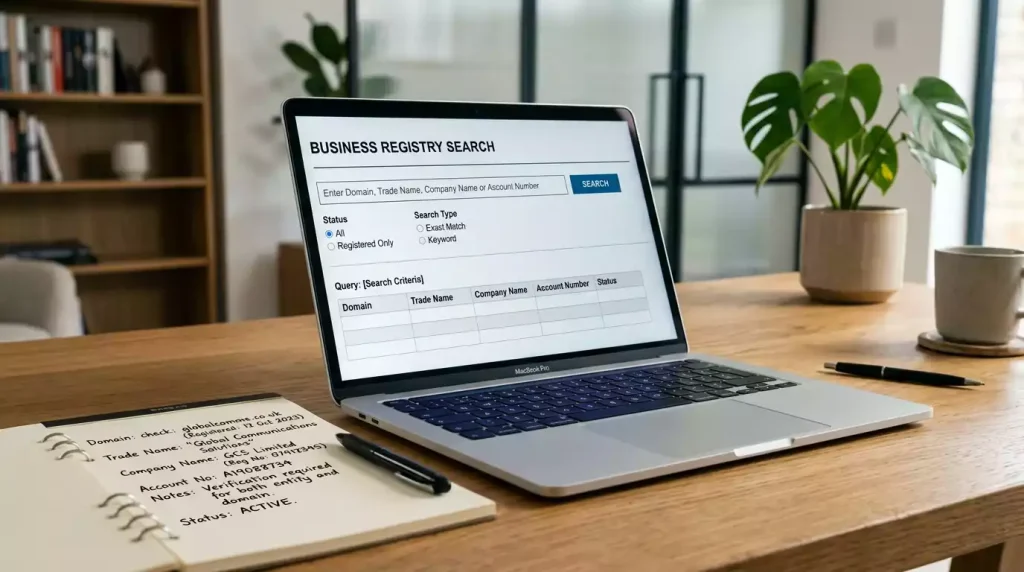
When a gambling website claims to be licensed, the claim should be checked against an official record rather than accepted from a footer badge, an advert or a copied sentence. The Gambling Commission publishes public registers for licensed businesses, individuals, regulatory actions and premises. For a Great Britain reader, those records are the sensible starting point for accountability checks.
This page explains how to approach that check. It does not say that a matching record makes a site safe, fair, suitable for you or free of future disputes. A register check answers a narrower question: can you connect the website’s claims to an official record, and do the details line up clearly enough to continue your wider review?
The wider picture is in our guide to checks, risks and support.
Gather the details before you search
Start with the information shown on the gambling website itself. Do not rely on a nickname used in an advert. Look for the exact domain, the company or business name, any trading name, and any account number or licence wording shown in the footer, terms, help pages or responsible gambling pages. If the site uses several similar names, write them down separately instead of assuming they all refer to the same business.
The reason for gathering details first is simple: the Gambling Commission business register can be searched by business name, trading name, domain name or account number. A careful search may need more than one of those details. If the website only gives vague wording and no checkable information, that is itself important. You should not have to guess who is taking your money or handling your documents.
Keep a dated note of what the site displayed when you checked. Licence and regulatory information can change, so current official pages should be relied on for time-sensitive details. A screenshot can be helpful for your own records, especially if the website later changes wording around ownership, terms or contact routes.
Use the official register directly
Go to the Gambling Commission public register or business register through the official site. Search the details you gathered one at a time. A domain search may be useful if the domain is shown in the record. A trading-name search may help when the public brand is not the same as the business name. An account number, if displayed by the site, can be another way to reduce confusion.
Do not treat a search result as a quick yes-or-no badge. Read the fields carefully. Compare the name on the website with the business name and trading name in the record. Compare the domain if a domain is shown. Look at whether the site you are viewing is the same site referred to in the official record, rather than a similar-looking brand, a copied name or a different domain.
| What to search | What to compare | What a mismatch should make you do |
|---|---|---|
| Domain name | The exact website address shown in the record, if available | Pause if the domain is absent, different or only loosely similar |
| Trading name | The public brand used on the site against the names in the record | Do not assume a similar name belongs to the same business |
| Business name | The legal or operating name behind the website | Check whether the terms and footer use the same business identity |
| Account number or licence wording | The number or wording displayed by the site against official entries | Use the official record, not the site’s wording, as the reference point |
If a record is difficult to connect to the site, that does not give you permission to fill in the gaps. A cautious reader should treat uncertainty as a reason to stop and ask a different question: why is the business identity not clear enough to verify?
How to interpret what you find
A clear official match can show that a business is listed in the register, but it is not a recommendation to gamble. It does not remove the need to read identity checks, payment restrictions, withdrawal terms, bonus conditions, customer-funds wording or complaint procedures. It also does not override your own self-exclusion, bank block or personal limits.
A missing result, partial match or confusing result should be handled carefully. Do not jump from “I cannot find it” to a legal conclusion about a specific site. At the same time, do not continue as though the uncertainty does not matter. For an ordinary user, the practical conclusion is enough: if you cannot connect the website to an official record you understand, you do not have the accountability clarity needed for a money decision.
Be especially careful with websites that use broad claims such as “internationally licensed”, “fully regulated” or “trusted by players” while making the actual business hard to identify. Those phrases may sound reassuring, but they are not the same as a clear record that you can check directly.
Step-by-step check sequence
- Copy the exact domain. Include the spelling and ending. Similar domains can refer to different websites.
- Find the business identity on the site. Look in the footer, terms, privacy page and account pages before assuming the public brand is the operator name.
- Search the official register directly. Use the Gambling Commission’s public or business register, not a copied link from a promotional page.
- Compare more than one field. Domain, trading name, business name and account number may each reveal something different.
- Write down mismatches. Treat confusing or missing details as a reason to pause, not as a challenge to work around.
- Move to the next risk area. If accountability is clear, still read payment, ID, withdrawal and complaint terms before any deposit.
This sequence is deliberately plain. The purpose is not to become a licensing specialist. It is to avoid relying on a website’s own promises when there is an official record that can be checked.
What the register check cannot do
The register is only one part of a wider decision. It does not tell you whether a bonus is good value. It does not promise that a withdrawal will be quick. It does not guarantee customer service quality. It does not decide whether a personal document request is reasonable in your specific situation. It does not resolve a complaint you have already made.
Those limits are important because promotional pages often blur them. A site may use licensing language to make everything else feel safe. A careful reader keeps the questions separate. First, can I identify official accountability? Next, are the money terms clear? Next, do I understand what documents and data I may be asked to share? Finally, if something goes wrong, is there a complaint route I can follow?
If a site is outside GAMSTOP coverage, the register check also does not change what self-exclusion means for you personally. If you chose a protection because gambling was becoming harmful, a licence claim should not be used as a reason to restart. That belongs to a different decision: whether continuing gambling is right for you at all.
What the phrase itself means is explained in what UK readers should check first.
When to pause immediately
- The website does not clearly name the business behind it.
- The official record you find appears to relate to a different domain or trading name.
- The site relies on badges, screenshots or broad claims but gives little checkable detail.
- The terms make withdrawal, bonus or verification rules hard to understand before deposit.
- You are trying to gamble despite a self-exclusion, bank block or personal stop decision.
Pausing is not the same as making a legal accusation. It simply means you do not have enough confidence to send money or documents. That is a reasonable consumer boundary.
Related next steps
For a broader explanation of why these checks matter, read the UK context and boundary guide. If you already have a dispute, the useful next question is how to keep evidence and follow a complaint route, covered in the complaints and ADR guide. If self-exclusion or gambling pressure is part of the situation, read the protection and help page before continuing with any gambling decision.