

The phrase “casinos outside GAMSTOP” can mean several different things to a UK reader. It might describe a site that is not part of the GAMSTOP self-exclusion scheme. It might describe a website promoted from overseas. It might also appear in marketing that presents fewer checks or fewer limits as a benefit. Those meanings are not the same, and treating them as the same is where many bad decisions start.
This page is a boundary check. It does not list gambling sites, rate operators or suggest where to play. The useful first step is calmer: understand what is being claimed, check whether there is official accountability, and notice whether you are being pulled towards gambling despite a protection tool you previously chose.
The full guide is on our home page.
What “outside GAMSTOP coverage” can mean
GAMSTOP is commonly discussed as a self-exclusion route for online gambling. When a gambling website is described as outside its coverage, the phrase should not be treated as a recommendation or a shortcut. For a Great Britain reader, the more important question is whether the business is accountable through the official gambling framework and whether using the site would undermine a protection that was put in place for a reason.
Some readers arrive at this topic because they are checking a claim. Others arrive because a block, self-exclusion or account restriction has made gambling harder. Those situations need different responses. Checking a licence claim is a practical consumer step. Trying to get around a protective measure is a warning sign that the next step should be a pause, not a workaround.
The safest reading of the phrase is therefore not “an alternative place to gamble”. It is “a claim that needs careful checking, and possibly a sign that protection or support should come first”. That distinction matters because promotional wording often hides the parts of gambling that cause disputes: unclear ownership, vague terms, document requests after deposits, withdrawal limits, bonus restrictions, weak complaint routes or pressure to keep playing.
The first split: checking, pausing or seeking help
Before thinking about offers or account opening, make a simple distinction. Are you checking a website because you want to understand who operates it, or are you trying to continue gambling after a self-exclusion, bank block or other limit has stopped you? If it is the second situation, the block is doing protective work. Treat it as a reason to step back and use support, not as a technical obstacle.
| Situation | What it may indicate | Safer first response |
|---|---|---|
| You saw a licence claim and want to check it | The key issue is accountability and whether the claim matches an official record | Use the Gambling Commission public or business register and compare the domain, business name and trading name |
| You are self-excluded or using a bank gambling block | A protection tool is already active and should be respected | Pause before any deposit and consider support tools, blocking software or help guidance |
| You feel urgency because of losses, debt or stress | Gambling may be connected to harm rather than entertainment | Do not chase losses; consider support from recognised help services and financial guidance |
| A site promotes “no checks”, instant withdrawal or guaranteed access | The wording may be hiding identity, payment or complaint risks | Read the terms, check official accountability and do not rely on promotional promises |
This split is not about judging the reader. It is about matching the next action to the real problem. A licence check cannot solve gambling harm. A support page cannot prove a website is accountable. A payment page cannot make a vague operator trustworthy. Keeping those tasks separate helps you avoid being pushed from one anxiety into another.
What you can safely check yourself
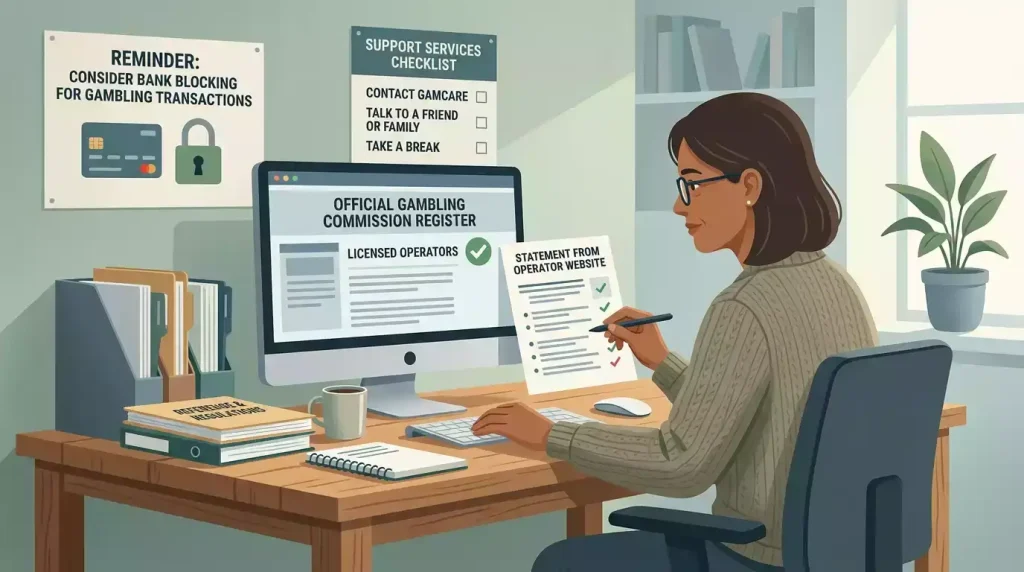
The Gambling Commission publishes public registers for licensed businesses and related records. Its business register can be searched by details such as business name, trading name, domain name or account number. That makes it a useful place to test a claim made by a gambling website. A match is not a promise that the site is right for you, and a missing or confusing result should not be treated as a puzzle to solve through guesswork. It is a reason to pause and avoid relying on the site’s own marketing language.
A careful check starts with information that appears on the gambling website itself: the domain, the name of the company, any trading name, and any account number or licence wording displayed in the footer or terms. The official record should be checked directly, not through a copied badge, screenshot or claim on a promotional page. A copied logo or a sentence saying “licensed” is not the same as an official record that you can compare.
There are limits to what a reader can conclude. A register check is about official accountability, not about quality, fairness in a specific dispute, withdrawal speed, customer service or whether gambling is personally safe for you at that moment. If you have already set limits, self-excluded, blocked gambling payments or are trying to stop, a register result should not be used as a reason to restart.
Risk signals that belong in your first review
Promotional pages around this topic can focus on convenience while avoiding the details that matter when money and personal documents are involved. The following signals are not proof of wrongdoing on their own, but they are practical reasons to slow down.
- Vague ownership: the site does not clearly show who operates it, or the trading name does not match the business you can check.
- Unclear licence wording: a licence is mentioned without enough information to compare it with an official record.
- Pressure around speed: claims focus on instant access, instant withdrawals or easy approval without explaining verification and terms.
- Protection framed as inconvenience: self-exclusion, bank blocks or identity checks are described as barriers rather than protections.
- Document requests feel open-ended: the site asks for sensitive documents without clear privacy information or a clear reason.
- Complaint route is hard to find: terms do not clearly explain who to contact first and what happens if a dispute is not resolved.
The practical point is not to collect a long list of worries. It is to decide whether you have enough clarity to continue. If a basic accountability check is hard, the later stages of a dispute are unlikely to become easier.
Decision path for a careful reader
- Name the reason you are looking. If the reason is curiosity about a claim, continue with official checks. If the reason is to get around a protection, stop and use support instead.
- Separate the website from the business. A domain, brand and company name may not be the same. Gather each one before checking.
- Check official accountability. Use the official register rather than relying on badges, copied text or forum comments.
- Read money terms before any deposit. Identity checks, withdrawal terms, bonus conditions and customer-funds wording all matter before money is sent.
- Protect documents and accounts. If you are asked for ID, consider privacy wording, account security and whether the request fits the stage you are at.
- Pause when protection is already active. Self-exclusion, blocking software and bank gambling blocks are there to create distance from gambling.
This path avoids two extremes. It does not pretend every website outside GAMSTOP coverage is the same. It also does not turn the phrase into a route around safeguards. A safer approach is specific, documented and honest about personal risk.
How the other checks fit together
If your question is mainly about licensing and accountability, the next page explains how to check a gambling site on the official register. If your question is about deposits, ID, withdrawals or bonus conditions, read the payment and verification checks before considering any transaction. If the real issue is self-exclusion, blocks or gambling pressure, go to the protection and help guide rather than looking for another way to play.
The first practical step is checking the official register.
That order is deliberate. A broad overview should not try to answer every detailed question at once. It should help you choose the right next question. The wrong next question is usually the one that ignores the biggest risk in front of you.
A calm safety note
If you are self-excluded, using a bank gambling block or feeling pulled to gamble because of losses, boredom, stress or debt, treat that as important information. GambleAware describes protective steps including GAMSTOP, blocking software, bank gambling payment blocks and venue self-exclusion. Money guidance can also matter where gambling has affected bills, borrowing or relationships. Support is most useful when it is used early, before a new account or deposit turns a difficult moment into a larger problem.
A gambling website should never be assessed only by how quickly it lets you in. The better question is whether you can clearly identify who is accountable, whether the money and document rules are understandable, and whether continuing would respect the limits you have already set for yourself.