

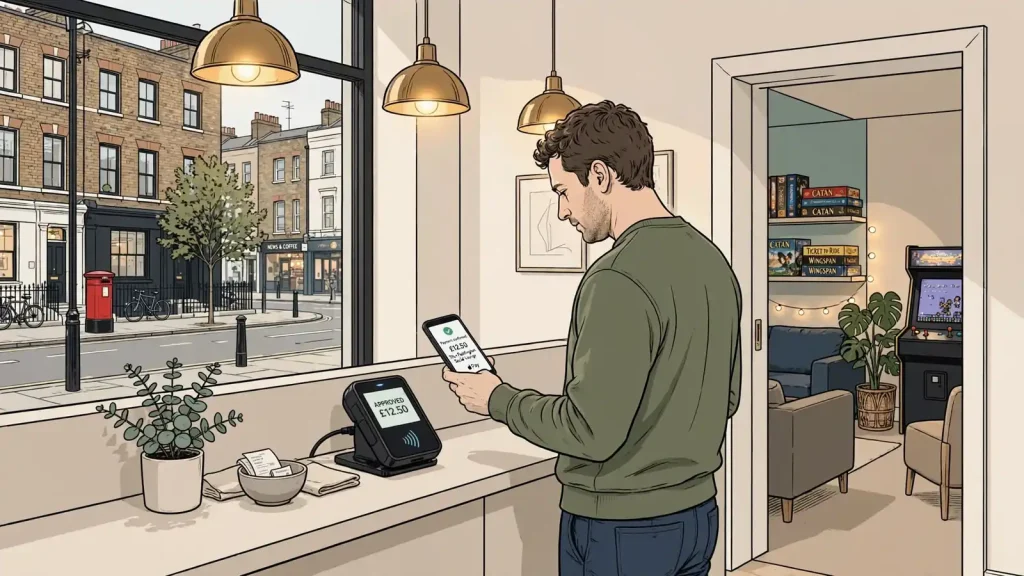
No-account describes the onboarding process, but identity checks and customer records may still be part of playing.
How No-Account Casino Play Works in Practice
“No-account” describes how a casino presents the first steps of play; it does not mean that the operator knows nothing about you or that you can play without checks. The label is commonly used for a flow in which you begin without completing a conventional registration form. Instead of choosing a username and password and filling in account details first, you may be asked to provide information through a payment or identity process. The exact sequence depends on the operator and the method it offers.
That difference is about the order and presentation of the steps, not the underlying relationship. The operator still needs to associate activity with a particular customer. A payment can help link a deposit to you, but it does not, by itself, establish every detail the operator may need. Likewise, skipping a visible sign-up page does not make the play anonymous. Treat “no-account” as a description of onboarding, not as a promise that no customer record, identity information or checks will exist.
What the first visit can look like
A typical no-account journey begins on the casino site, where you choose a way to fund play and provide whatever details that route requires. The payment may act as the initial link between you and the casino. Once the transaction is accepted, the site may open a playing session without asking you to create the usual login credentials first.
Choosing a Casino: UK Options and Key Considerations
That can make the opening sequence feel shorter, but it does not remove the stages that follow. You still need to be able to return to the same play record, see its balance and request any eligible funds. If the first payment was used to identify the session, the operator may rely on details connected with that payment to recognise you later. If those details are incomplete, inconsistent or no longer accessible, the operator may need another way to confirm that the account activity belongs to you.
The phrase “no account” can therefore be misleading if read literally. In practical terms, it often means that you do not begin by setting up a standard account in the familiar way. It does not necessarily mean there is no account-like record behind the screen, nor does it guarantee that every later task can be completed using only the details supplied at the start.
Why withdrawal can involve more questions
The difference between an initial deposit and a later withdrawal is important. At the point of funding, the casino can receive a payment through the chosen route. Before releasing winnings, however, it may need to establish who is asking for the money and whether the payment method belongs to that person. Identity or payment-ownership questions can arise before a withdrawal, even when the initial play required little or no conventional registration.
No ID Verification Casino Withdrawals in the UK
This is why a smooth first deposit should not be taken as evidence that all future steps will be automatic. A name or other detail associated with the payment may need to match the information provided later. The operator may also ask for information that was not requested at the start. If you cannot access the payment method used for the initial play, or the operator cannot connect it clearly to you, resolving the difference may take additional steps.
The no-account label does not tell you exactly which checks will be made, when they will occur, or what documents might be requested. Those details depend on the operator and the circumstances of your play. The useful distinction is simpler: not having to complete a standard registration form at the beginning does not remove the possibility of identity or payment checks later.
What the label does not promise
A no-account casino is not necessarily a casino with no password, no personal information or no customer record. Some services may use a payment-linked process; others may ask for details at a later stage or provide a way to access play without the conventional account setup. The label alone does not specify which design is in use.
"No-account" describes the onboarding flow rather than anonymity; the operator will still need to associate your activity with your identity and undergo necessary checks.
Nor should you assume that the casino will never need to pause a transaction while it checks information. If the details linked to your play do not answer the operator’s questions, further confirmation may be needed before a withdrawal. This is not a contradiction of the initial sign-up flow: the flow and the later checks serve different purposes. The first gets play started; the later step can establish that the person requesting funds is entitled to receive them.
When you encounter a new no-account casino, read the label narrowly. It tells you something about how the first interaction may be arranged, but little about what happens once you return, manage your play or request a withdrawal. Pay attention to what information is requested at the start and understand that the operator may still ask who you are or who owns the payment method before releasing funds.
Our top casino picks for the UK
- Revery PlayBonus: 100% up to€1,000+ 100 FS · Payout speed: 1-3 business days
- SpinFormulaBonus: 550% Up To £15,000 + 550 FS · Payout speed: 1-3 business days
- BritsinoBonus: Welcome Package – Get your £2,200 + 2,000 FS · Payout speed: 1-3 business days
- ZombillionBonus: Welcome Pack 250% up to £4000 + 200 FS · Payout speed: 1-3 business days
- NightLuckBonus: Welcome Pack + 805% Up To 6400€ + 280 FS · Payout speed: 1-3 business days
- BeOnBetBonus: 100% up to €500 + 100 FS · Payout speed: 1-3 business days
- WinBeastBonus: €5000 + 500 FS + €650 Freebet · Payout speed: 1-3 business days
What UK Gambling Commission Licensing Means for You
When you consider a remote casino, the key regulatory question is whether it is authorised to provide gambling to customers in Great Britain. The operator’s address, the location of its servers and the place where its games are hosted do not change that requirement. A business offering remote gambling to people in Great Britain needs the relevant licence from the UK Gambling Commission.
Non-UK Licence Casinos: What the Licence Means
This rule applies to the service being offered, not just to the company’s country of registration. An operator cannot avoid the British licensing framework by placing its business or technical equipment abroad while continuing to serve customers in Great Britain. The Commission’s remit over remote gambling follows the market the service reaches, rather than the physical location of the equipment that supports it.
What the regulator’s role covers
The UK Gambling Commission oversees commercial gambling in Great Britain, including online casino activity. It is the sole regulator for commercial gambling there. Its role is not limited to land-based venues or to companies incorporated in Britain: it covers remote gambling offered to consumers in Great Britain as well.
The licensing system distinguishes between the business providing the service and the individuals who operate within the gambling sector. The Commission grants operating licences to businesses and personal licences to individuals working in relevant operating roles. These are different forms of authorisation: a personal licence does not replace the operating licence required by the business offering gambling to customers.
For you, this distinction explains why a casino’s branding or customer-facing website is not, by itself, the legal basis for its operation. The relevant question is whether the business responsible for the gambling service holds the necessary authority to provide it in Great Britain. The site may present the experience as a simple, direct way to play, but the regulatory obligation attaches to the operator behind that service.
Why the operator’s location is not decisive
A remote casino can be managed from another country and still target customers in Great Britain. That foreign location does not remove the need for a Gambling Commission licence when the operator serves consumers in this market. Nor does moving the game platform, payment infrastructure or other key equipment overseas alter the licensing requirement.
Attention An operator’s registration address or technical equipment location outside of Britain does not exempt them from requiring a UK Gambling Commission licence to serve UK customers.
This is important when a service describes itself as international or points to a registration address outside Britain. Those details may explain where parts of the business are based, but they do not determine whether the operator needs permission to offer remote gambling to people in Great Britain. The relevant connection is that the service is being provided to consumers here.
The rule concerns the operator’s legal position, not the wording used to describe a casino. Labels such as “no-account” explain a feature of the customer journey; they do not create an exception to the licensing framework. A casino does not become exempt because it allows play to begin without a conventional account-creation process. If the business offers remote gambling to consumers in Great Britain, it needs the applicable Commission licence.
The geographical scope
The Commission regulates commercial gambling in Great Britain. The Gambling Act 2005 applies in England, Wales and Scotland, but not in Northern Ireland, so Great Britain and the United Kingdom should not be treated as interchangeable terms when describing the scope of this licensing rule. The Commission’s role as the sole regulator for commercial gambling in Great Britain is the relevant framework for remote casinos serving consumers there.
That distinction also helps keep claims about location precise. A statement that an operator is “based in the UK” does not, on its own, explain whether it is authorised for the service it provides. Conversely, an overseas base does not by itself settle the question against the operator. What matters for remote gambling is whether the business holds the relevant Gambling Commission licence to serve consumers in Great Britain.
Non-GamStop Curaçao Casinos: Coverage and Risks
The licensing framework therefore follows the offer into the market. It applies to commercial online gambling activity and to the business making that activity available, even where important parts of the operation are located elsewhere. No-account casinos are still remote gambling services; the way a customer starts playing does not change which regulator’s licence the operator needs.
How to Assess a No-Account Casino’s Claims
A “no-account” label describes a claimed sign-up route, not proof that a casino is trustworthy or that its terms are suitable. Treat each part of the offer as a separate claim: who operates the site, whether that operator holds the required licence, how the advertised play route works, and what rules apply to deposits, bonuses and withdrawals. A polished page, a familiar brand name or a positive review cannot establish those points by itself.
Match the operator to the licence
Start with the UK Gambling Commission’s public register. Search for the legal business named in the site’s terms, rather than relying only on the casino’s trading name. Compare the register entry with the domain you intend to use and with the company details shown on the site. A licence associated with a similar name is not, by itself, evidence that the particular operator or domain is covered.
This check matters because a casino serving consumers in Great Britain needs the relevant Gambling Commission licence. The operator’s location does not settle the question. If the site does not make the responsible business clear, or its stated company and domain cannot be matched to the register, do not treat its licensing claim as confirmed.
Verify the licence
Before playing, search the UK Gambling Commission’s public register for the legal business name mentioned in the terms. Do not rely solely on the casino’s trading name or domain.
Register information is time-sensitive. For instance, a specialist review reported that the public register dated 26 September 2026 did not identify a LuckyPays entry under that brand or its stated domain, including luckypays.io. That is a dated finding, not a permanent conclusion about every later version of a register or any other business. Check the current record yourself before relying on a claim.
Read the live terms, not the headline
A review may describe a casino as requiring no account, but the operator’s current terms determine what the service actually asks you to do. Look for the legal operator, the relevant domain, the conditions attached to the advertised play route, and the rules that apply when you later request a withdrawal. If the review’s description conflicts with the live terms, the terms are the more direct evidence of the operator’s stated conditions.
Apply the same discipline to no-account casino bonuses. An offer shown in a review may have expired, changed or been presented without its restrictions. Find the promotion on the operator’s own site and read the complete terms before opting in. Check which games qualify, how wagering is calculated, when the offer expires, how free spins are treated, and what withdrawal conditions apply. The maximum win and wagering terms should be visible within one click of the offer. If a review gives a bonus figure but the live promotion does not confirm it, do not assume that figure is still available.
Non-GAMSTOP Casinos in the UK: What Access Means
Judge reviews by what they prove
A useful no-account casino review separates observable details from opinion. It should identify the operator and domain it assessed, explain when its information was checked, and point you to the relevant register entry and live terms. Broad claims such as “trusted”, “instant” or “no checks” are not evidence unless the review shows what they mean and where the supporting conditions can be verified.
Look for consistency across the review, the operator’s terms and the register. A mismatch is a reason to pause and investigate, not a detail to explain away with a brand resemblance or an advert. A review can help you locate claims to verify; it cannot substitute for checking whether the specific operator and offer are current.
What a No-Account Casino List Can—and Cannot—Tell You
A no-account casino list is a directory of offers, not proof that every entry is current or suitable for you. Its value depends on how each listing is supported: does it identify the operating company, link to the actual casino, and show where the claim about account-free play comes from? If those details are absent, the list gives you a name to investigate, not a verified option.
Do
- Check the live operator site for current terms
- Verify the business on the UKGC public register
- Confirm both deposit and withdrawal methods
Don’t
- Assume sister sites share the same licence
- Rely on outdated review descriptions
- Treat deposit methods as guaranteed withdrawal routes
A listed brand and the business behind it are not necessarily the same thing. A comparison page may group brands as sister sites because they appear to share ownership, management or a platform. That association does not establish that the same company holds the relevant operating licence for each site, or that the sites use identical rules. Treat “sister site” as a relationship claim that needs checking, not as a shortcut to conclusions about regulation or player terms.
Read each entry as a set of separate claims
A listing can combine several statements that require different evidence:
- The casino offers no-account play. Check the live casino site to see how its stated process works; a directory description can become outdated.
- The brand belongs to a named group. Look for clear identification of the operating company and whether the relationship is stated by the businesses themselves.
- The offer is available. Confirm that the promotion appears on the operator’s current site and read its terms before relying on it.
- The casino is authorised for Great Britain. Check the relevant operator and domain in the Gambling Commission’s register. A brand name alone may not identify the legal entity or domain accurately.
These claims are independent. Evidence for one does not prove the others. For instance, a promotion displayed on a listing does not demonstrate that it remains available, while a shared brand association does not establish the licensing status of a particular casino domain.
Be especially careful when a page presents a list as if every entry has been checked but gives no checking date or links only to its own commentary. A date tells you when the page was reviewed, not whether the operator’s offer still stands. The decisive information is the operator’s live wording and the regulator’s entry for the business serving customers in Great Britain.
A dated example shows why brand-level assumptions can mislead. A specialist review reported that the Gambling Commission’s public register, dated 26 September 2026, did not identify a LuckyPays entry under that brand or its stated domain, including luckypays.io. That is a specific report about the register on that date; it should not be turned into a general claim about other brands or treated as a substitute for checking the current register yourself.
Anjouan Casino Licence in the UK: What It Means
The same discipline applies to a no-account casino bonus shown beside a listing. The directory may describe an offer, but only the operator’s live promotion and full terms can establish what is being offered and under what conditions. If the listing and operator page differ, rely on the operator’s current terms rather than assuming the directory has captured a change.
A useful list narrows the work by pointing you to identifiable operators and primary information. It cannot certify a brand, a sister-site relationship, a licence or an offer merely by placing them together. Check those items separately before treating an entry as an option.
Funding Play and Getting Winnings Back
Treat the route into a casino and the route back out as separate parts of the transaction. A payment method that lets you deposit does not necessarily appear among the withdrawal options. Before funding play, check which methods the operator accepts for deposits and which it permits for withdrawals; otherwise, you may have to arrange a different route to receive winnings.
Important Mobile billing is a one-way street; while it can be used to fund a deposit, it cannot be used to receive your winnings. You must have an alternative withdrawal method ready.
This distinction matters with pay by mobile. The charge is added through your mobile billing arrangement, so it can fund a deposit, but a withdrawal cannot be credited to your phone bill. A UKGC-licensed casino must offer another way to process withdrawals, such as a bank transfer, debit card or regulated e-wallet. Confirm that you can use one of the available withdrawal methods before choosing mobile billing for a deposit.
Carrier billing also has limits that affect how much can be put through it. A specialist review reports a monthly ceiling of £240 for carrier-billed deposits. That figure should be treated as a reported limit, not assumed to apply identically to every operator or billing arrangement; check the current payment terms before relying on it. The same review reports a £30 limit for a single Boku deposit. If a payment is declined or exceeds a stated limit, splitting it into repeated transactions is not a sound workaround unless the operator and payment provider explicitly allow it.
A no-account flow does not remove these practical constraints. Even if the initial payment is handled without creating a conventional account, the casino still needs a valid route for any withdrawal. The payment provider, the casino’s cashier and the withdrawal method all have distinct roles: the provider handles the deposit, the casino records the funds and any resulting balance, and a separate payment channel may be used to send money back.
No Minimum Deposit Casino UK: £1 Deposits Explained
Before depositing, look for the withdrawal methods in the cashier or payment terms rather than inferring them from a deposit logo. Check whether the method is available to you, whether it requires payment details in your name, and what steps the casino requires to process a withdrawal. Identity or payment-ownership questions can arise before funds are released, so a deposit that succeeds does not by itself establish that a later withdrawal will use the same route or be immediate.
How to Read a Casino Bonus Before You Opt In
A bonus changes the conditions attached to play; it does not simply add funds you can withdraw. For a no-account casino deposit bonus, start with the live promotion and its full terms, not a banner or a summary. Check that the offer is current and that the terms identify the eligible games, expiry, how free spins are credited or converted, and what must happen before any winnings can be withdrawn.
The wagering requirement describes how much qualifying play must take place before bonus-related winnings become withdrawable. Read what the multiplier applies to: the bonus alone, or the bonus and deposit together. Then check which games count and whether they contribute at different rates. A headline figure without those details cannot tell you the amount of play required.
For Great Britain-facing incentives, a specialist review reports a UK Gambling Commission rule effective from 19 January 2026 that caps wagering requirements on bonus funds at ten times. Treat that as a dated regulatory point, then read the operator’s current terms to see how the offer is structured. A single incentive cannot combine more than one gambling product type.
UK Gambling Commission rules may cap wagering requirements on bonus funds. Always check the live terms for the specific multiplier and which games contribute to it.
A no-account casino UK no-deposit bonus may be presented as free spins or bonus credit, but the label does not explain the restrictions. A specialist review describes no-deposit free-spin offers as typically providing between ten and thirty spins on nominated slots. That is not a promise about a particular promotion: check the live offer for the named games, spin value, expiry, and whether winnings carry separate wagering or withdrawal conditions.
Also locate the maximum-win cap and the wagering terms before opting in. Both must be visible within one click of the bonus offer. If a cap applies, it can limit what you keep even after completing the wagering requirement. Check whether withdrawing early cancels the bonus or affects winnings, and whether accepting the offer changes any other terms of play.
If a key condition is unclear, do not infer it from the promotion’s headline. The live terms determine how the offer works.
No Account Does Not Mean No Checks
A casino that lets you begin without a conventional registration form has removed a step from the opening flow; it has not removed the checks attached to real-money gambling. Before you can deposit, the operator must verify that you are old enough to gamble. A quick start, a saved payment detail or a phone-billing option does not replace that age check.
Age verification and identity verification are related but distinct. The first establishes whether you may deposit. Identity checks can also be needed to confirm that the person using the service matches the details associated with the play. Payment ownership may be questioned as well. These checks can arise before a withdrawal, even if the initial deposit appeared to go through without a full account form.
Casino No ID Verification UK: What It Really Means
Paying by mobile changes only how money is added. It does not waive age or identity checks, and it does not establish that the phone number or billing arrangement belongs to the person playing. Treating the payment route as proof of eligibility confuses two separate processes: the operator checks who may gamble, while the payment channel handles a transaction.
This distinction matters if you are looking for a casino without account creation. “No account” describes the sign-up experience, not an exemption from verification. If requested details cannot be matched or confirmed, a withdrawal may be delayed while the operator resolves the question. Read the operator’s verification information before depositing, and make sure you can provide accurate details if asked. A simplified start can reduce form-filling, but it cannot guarantee that you will never need to identify yourself.
Trustly, Deposits and Withdrawals
If you are considering a no-account casino that mentions Trustly, separate two questions: whether the method can fund play and how winnings can be paid out. A deposit option does not, by itself, establish that the same route is available for withdrawals. The casino’s payment terms determine the available cash-out methods, and those terms may specify a different route.
This distinction matters because a payment method can be suitable for sending money to a casino without being the method used to return it. Before depositing, find the withdrawal section in the operator’s current terms and check which methods are listed, whether any conditions apply, and whether you need access to a separate account or card to receive funds. Do not infer withdrawal availability from a payment logo or from the fact that a deposit option appears at checkout.
Trustly usage
Trustly is often used as a deposit method, but it does not guarantee that you can withdraw via the same route. Always check the cashier’s specific withdrawal options.
For UKGC-licensed casinos, withdrawals must be processed through an alternative method, such as a bank transfer, debit card or regulated e-wallet. So if you are looking for a Trustly casino without account creation, treat the Trustly label as a question about the deposit route, not as proof of the full payment flow. Confirm the operator’s own current information before you send money, including how it handles withdrawals if your preferred deposit method is not offered for cashing out.
Keep the two stages distinct when comparing offers: a listed deposit route tells you how funds may enter play; the withdrawal terms tell you how winnings can leave. If the latter are unclear, do not assume the deposit method will also work in reverse.
Paysafecard and the No-Account Payment Question
Seeing Paysafecard mentioned alongside a casino does not tell you whether you can play without creating an account. The payment method and the sign-up process are separate parts of the service. A casino might offer a particular way to fund play while still requiring an account, or it might describe its entry process as account-free while supporting different payment options. The payment name alone cannot establish which arrangement applies.
Check the casino’s own current payment and account information before relying on an advertised claim. Look for whether Paysafecard is listed for deposits, what steps the operator requires before play, and whether the method is available to customers using the specific no-account route. Do not infer availability from a general statement about prepaid payments or from another casino’s terms.
Jackpot Mobile Casino UK: Slots, Payouts and Terms
Deposit and withdrawal arrangements also need to be considered separately. A method that can fund play does not necessarily support cashing out. UKGC-licensed sites must provide withdrawals through an alternative route, such as a bank transfer, debit card or regulated e-wallet. That means the advertised deposit option should not be treated as the promised route for returning winnings.
Before depositing, identify the withdrawal methods the casino offers and whether you can use one that suits you. Read the current terms for any steps that connect the original payment to a withdrawal, and confirm what information the operator requires. If the payment page describes deposits but says nothing clear about withdrawals, treat those as unresolved details rather than assuming the same method works in both directions. This lets you assess the payment route without confusing it with the separate question of whether the casino permits play without a conventional account.
Mobile Play: What the Rules Change
Playing on a phone changes how you interact with the casino, but it does not change the rules that govern deposits or online slots. Two practical details matter: paying through your mobile bill can fund play but cannot return winnings to that bill, and online slots do not offer autoplay. Each spin must also last at least 2.5 seconds.
Mobile Play Rules
- Online slots in Britain do not support autoplay
- Every individual spin must last at least 2.5 seconds
- Mobile billing is limited to deposits only
Pay by mobile is a one-way deposit route
If a casino offers pay by mobile, the charge is added to your phone bill or deducted from your prepaid balance. That makes it a way to put funds into play, not a complete payment loop. Withdrawals cannot be credited back to the phone bill, so you need to use a separate method to receive any money the casino approves for withdrawal.
This distinction matters when you are using an online casino without an account-creation step. A mobile billing option may make the initial payment feel like part of the phone service, but it does not remove the need to understand how the casino handles money later. Before depositing, check which withdrawal methods the casino offers and whether you can use one that suits you. Do not assume that a payment option shown at deposit will also appear when you request a withdrawal.
The same principle applies when you play from a mobile browser or app: the device does not determine whether a method can be used for cashing out. Pay by mobile remains deposit-only. If you choose it, treat the deposit as money already sent through that route; plan separately for withdrawals.
Slot controls on a phone
Online slots in Britain cannot autoplay. You must start each spin yourself rather than instructing the game to repeat spins automatically. This remains true on a small touchscreen, even if the game’s layout makes its controls look different from those on a desktop.
A spin must last at least 2.5 seconds. That minimum applies to the spin itself, not to how quickly you tap the button or move between screens. A rapid tap cannot make the result arrive sooner than the required duration, and a mobile interface cannot shorten the spin below that limit.
Non-UK-Regulated Casinos: Licensing and UK Rules
In practice, the controls give you a clear sequence: choose the stake, start a spin, wait for it to finish, then decide whether to start another. The absence of autoplay means the game cannot continue while you stop watching or attend to something else. It also means the next spin is a separate choice rather than part of a repeating instruction.
That distinction is useful when assessing a free online casino experience on a phone. “Free” describes the payment arrangement for the play being offered; it does not mean slot controls are unrestricted. If the game is an online slot, autoplay is not available and each spin has to meet the minimum duration. A casino with no account may change the route into play, but it does not change these operating constraints.
What to check before playing on mobile
Look at the payment screen and the withdrawal information as separate parts of the process. If pay by mobile is listed for deposits, confirm what method would be used for an approved withdrawal. The phone bill cannot serve as the destination for winnings. This is a functional limitation of the payment route, not a setting you can change in the slot game.
Then check the slot controls before committing funds. You should expect to start spins individually and allow each one to run for at least 2.5 seconds. If a game appears to offer automatic repeated spins, that feature cannot be used for online slots in Britain. The relevant constraint is the way the game operates, not whether you are playing through a mobile site, an app, or a larger screen.
These details are especially easy to miss when a “no account” label draws attention to the first step of play. The label does not tell you whether phone billing is suitable for your whole money journey, and it does not indicate that mobile slot controls work differently. Keep the two decisions separate: choose a deposit route with a distinct withdrawal plan, and expect each online slot spin to be a deliberate, timed action.
Is LuckyPays licensed by the UK Gambling Commission?
No. The UK Gambling Commission’s public register dated 26 September 2026 does not list LuckyPays under its brand or stated domain, luckypays.io.
Do all games count toward bonus wagering?
No. From 19 January 2026, a single incentive cannot combine more than one gambling product type, and bonus wagering requirements for Great Britain-facing incentives are capped at 10 times.
What is the maximum wagering requirement in Great Britain?
The maximum is 10 times the bonus funds for Great Britain-facing incentives under UKGC rules effective from 19 January 2026.