

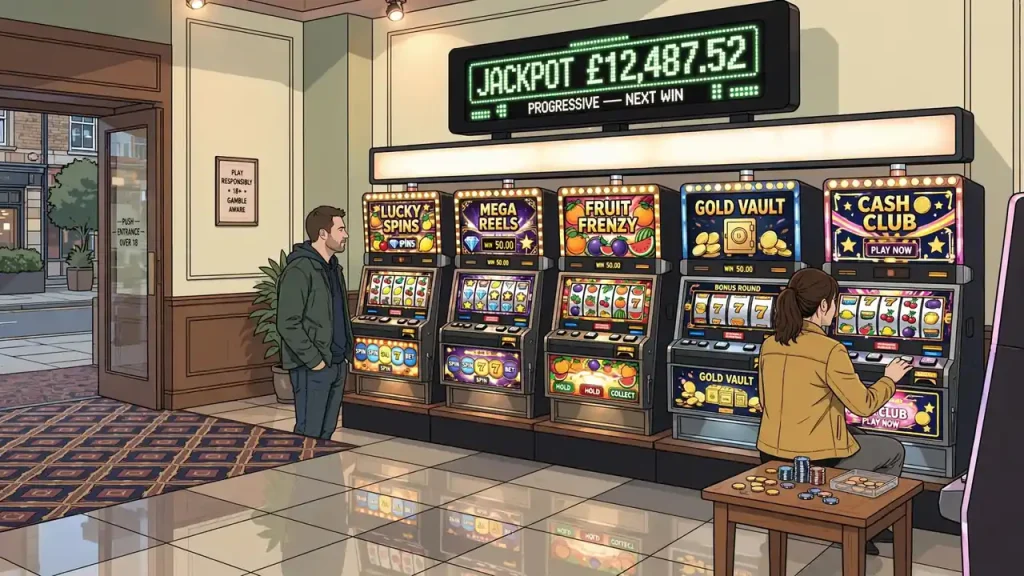
See how contributions, jackpot rules and payout trade-offs shape the experience of playing progressive slots.
How Progressive Jackpot Pools Build
A progressive jackpot grows because a portion of each qualifying wager is added to a prize pool. The slot’s other functions remain in place, but the jackpot has a separate funding mechanism: connected machines send contributions into the same pool rather than keeping every wager’s jackpot contribution within that individual machine. This is how progressive slots online in the UK can display a prize that rises as people play.
The contribution is calculated from the wager, not added as a separate charge after the spin. Progressive jackpot slots typically direct between 1% and 3% of each wager to the pool. If a player stakes more, the amount allocated to the jackpot is larger in proportion to that stake; if the stake is smaller, the contribution is smaller too. The exact amount depends on the game’s design. The stated percentage describes the part directed to the jackpot pool, not the player’s chance of winning or the amount returned through ordinary play.
A simple way to picture the mechanism is to treat the pool as a shared counter. A wager is made on a connected slot, the game allocates its jackpot portion, and that portion increases the counter. Further wagers add further contributions. The displayed jackpot is therefore not a fixed prize funded once when the game launches. It changes as eligible play sends money into the pool, subject to the game’s own rules for how the prize is awarded and reset. Those award rules determine what happens to the counter when someone wins; they are separate from the funding process described here.
From one machine to a shared pool
The word “progressive” refers to the changing prize, but the system can operate at different scales. A pool might receive contributions from connected machines within a particular installation, or it may be configured as a network jackpot for the same game across multiple operators. In either case, the essential link is that those machines are connected to the same progressive pool. A machine that is not part of that connection does not add contributions to it merely because its game looks similar.
Top Rated Online Casinos UK: Amatic Games Explained
For a network jackpot, the shared pool can span operators carrying the same progressive slot game. A player using one operator’s version is then contributing to a pool that can also receive contributions from connected versions elsewhere. The game’s identity and network connection matter: the shared prize is not automatically common to every casino, every game from a provider, or every slot with a similar theme. It is tied to the specific progressive game and the network arrangement behind it.
This arrangement explains why a network prize can grow beyond the contributions made by customers at one casino alone. Each connected operator supplies access to the same game, and wagers on those connected machines feed the shared pool. The prize display may be visible in more than one place because the underlying counter is shared, rather than because each operator has created an independent jackpot of the same size. If two versions are not connected to the same pool, their counters are separate even if their titles or presentation appear alike.
Amatic Games at UK Online Casinos: How They Work
Why the displayed total changes
The pool’s displayed value responds to contributions from play across its connected machines. When activity adds contributions, the total rises; the pace of that rise depends on the amount and frequency of wagers entering the pool. That does not mean the visible amount represents all money wagered on the game. Only the portion assigned to the jackpot is directed there. The remainder is handled according to the game’s other payout structure.
A progressive penny slot follows the same basic funding logic as another progressive slot: a portion of each qualifying wager contributes to its pool. The label “penny” does not, by itself, establish how much is added, whether the pool is local or networked, or which operators share it. Those details belong to the individual game’s setup. A low denomination therefore does not tell you the size of the network or the way its displayed jackpot is funded.
The distinction between a game and its pool is useful when comparing online progressive slots. The game supplies the rules and presentation; the pool configuration determines which connected machines contribute to the prize. Two operators can offer the same progressive game and connect to the same network pool, while a visually similar title may operate a different pool. The title alone is not enough to identify the funding arrangement.
DO
- Read the game’s information panel to identify jackpot triggers
- Check if the top tier requires a minimum qualifying stake
- Verify if the jackpot is part of a networked pool
DON’T
- Assume a high jackpot amount means a win is imminent
- Infer eligibility solely from the game being progressive
- Assume every version of a game uses the same prize pool
When you see a progressive jackpot figure, read it as the current value of a pool receiving contributions from connected play, not as a prize funded solely by the last player or by one casino. Each qualifying wager adds its allocated share, and connected machines can make those additions across operators. That shared funding mechanism is what allows a network jackpot to grow beyond a single machine while remaining attached to a particular progressive game.
Our top casino picks for the UK
- Revery PlayBonus: 100% up to€1,000+ 100 FS · Payout speed: 1-3 business days
- SpinFormulaBonus: 550% Up To £15,000 + 550 FS · Payout speed: 1-3 business days
- BritsinoBonus: Welcome Package – Get your £2,200 + 2,000 FS · Payout speed: 1-3 business days
- ZombillionBonus: Welcome Pack 250% up to £4000 + 200 FS · Payout speed: 1-3 business days
- NightLuckBonus: Welcome Pack + 805% Up To 6400€ + 280 FS · Payout speed: 1-3 business days
- BeOnBetBonus: 100% up to €500 + 100 FS · Payout speed: 1-3 business days
- WinBeastBonus: €5000 + 500 FS + €650 Freebet · Payout speed: 1-3 business days
How Jackpot Triggers and Eligibility Work
A progressive jackpot is won when the game’s stated trigger condition is met. That condition depends on the slot: some award the prize through a random event, while others require a particular symbol combination or a bonus-round outcome. The growing pool does not, by itself, tell you which event awards it; the game rules define that.
With a combination-based trigger, the jackpot is tied to a specified result on the reels. A bonus-based trigger instead makes the jackpot available within a feature, where the rules describe what must happen to win it. Reaching the feature is not necessarily the same as winning the jackpot: you may need to complete a particular step or reveal a designated outcome. Check the game’s paytable and jackpot information to distinguish entry into a feature from the condition that awards the top prize.
Slots & Providers: UK Casino Game Guides
A random trigger works differently. It can award the jackpot without a particular reel combination being the cause. Random does not mean that every stake is eligible for every prize tier, however. A specialist review has reported that certain random-trigger progressive games set a minimum qualifying bet for the highest tier. Treat that as a game-specific condition, not a general rule for all progressive slots. The game information should state whether a qualifying stake applies and which jackpot tier it covers.
This distinction matters when you compare what happens on screen with the prize rules. A spin that looks like an ordinary result may still be eligible for a random award, while a visually distinctive combination may matter only in a slot whose rules assign it a jackpot trigger. Neither appearance alone proves that the top prize was available: eligibility and the award condition are separate parts of the game’s rules.
Before playing, identify three things in the game information: whether the jackpot is random or outcome-based; whether a bonus feature is involved; and whether the top tier has a qualifying-stake condition. If the rules make the minimum stake a condition of eligibility, staking below it means you do not qualify for that tier, even if the game can still award another prize. Do not infer eligibility from the displayed jackpot amount or from the fact that the slot is progressive.
There is no general method that changes a random trigger into a predictable outcome. For a combination or feature-based jackpot, the relevant question is whether the game has produced the specified condition. In either case, the rules—not the size of the pool or a spin’s appearance—determine whether a jackpot can be awarded.
Identify Jackpot Rules
- Determine if the trigger is random, combination-based, or bonus-based
- Check for any minimum qualifying stake conditions
- Confirm if the jackpot is local or networked
- Verify the prize award and reset rules
Networked, Mystery and Must-Hit-By Jackpots
Progressive jackpot slots can be classified by how the prize is organised. “Networked” describes the reach of a jackpot pool: the same game can connect participating machines across more than one operator, so the prize is shared rather than confined to a single machine or casino. The relevant connection is between copies of the same game that are linked to that pool; two progressive slots at one operator are not necessarily part of the same network.
A mystery jackpot describes how the prize is awarded, not how widely it is shared. Its trigger may be concealed from the player, and the jackpot can be awarded without a particular visible symbol combination. That format does not, by itself, tell you whether the pool is networked or confined to one operator. A mystery prize might belong to a shared network, while another might be limited to a smaller pool.
A must-hit-by jackpot is structured around a stated ceiling: the prize is designed to be awarded before it reaches that point. The displayed value can therefore help explain the format, but it does not mean that a particular spin is due to win. The ceiling describes a boundary for the jackpot mechanism, not a personal countdown tied to your session. Nor does the label alone establish whether the prize is shared between operators.
These terms answer different questions. “Networked” concerns where the pool is connected; “mystery” concerns whether the trigger is apparent; “must-hit-by” concerns the jackpot’s stated upper boundary. They can describe overlapping features rather than mutually exclusive game categories. When a title uses more than one label, read each as a separate part of its structure.
Classic Slots Online UK: How Spins and Features Work
The name of a format is not enough to determine a game’s exact conditions. A specialist review may describe a title as networked, mystery or must-hit-by, but the game’s own information and the operator’s rules are what you need to understand how its jackpot works. Availability can also vary between operators and change when providers update their catalogues, so a format label does not guarantee that a particular game will appear everywhere.
In Great Britain, the UK Gambling Commission regulates remote gambling offered to consumers, including where the operator’s key equipment is located. It is the sole regulator for commercial gambling in Great Britain and issues operating licences to businesses and personal licences to individuals working in the sector. These regulatory roles concern gambling activity and licensing; they do not make different jackpot formats interchangeable.
Finding Progressive Games Across UK Casinos
A progressive slot’s presence at one UK casino does not mean it will appear in every other casino’s games menu. Availability varies by operator and can change when providers update their catalogues. That makes a fixed list of progressive jackpot slots a poor guide to what you can play now: it may omit games available at your chosen operator or include titles that have since been removed.
The catalogue is assembled through agreements between operators and game providers. An operator may carry a provider’s standard slots without carrying every progressive title from that provider. A game can also be absent because it has not been added to that operator’s offering, or because its catalogue has changed. The practical result is that you need to check the casino’s current game library rather than infer availability from a game’s name or provider.
An operator’s game library is assembled through agreements with providers, meaning a game’s absence from one casino does not mean it is unavailable elsewhere.
Check the game, not just the casino
If you are looking for video slots with progressive jackpots, use the operator’s game search or browse its jackpot category, then open the game’s information panel. Confirm that the displayed prize is progressive and read the game rules to identify which jackpot the game offers. A jackpot label alone may not tell you whether the prize belongs to that game’s own pool or is shared across a wider network.
This distinction matters when comparing the same title across operators. Where a progressive jackpot pool is networked, operators carrying that same game share the pool. The casino is therefore a point of access to the game, not necessarily the sole source of its jackpot. If the game is not listed by an operator, that does not establish that the title has been withdrawn everywhere; it only tells you that you cannot confirm its availability there from that catalogue.
For a useful check, search the operator’s library for the exact game title and inspect the game page rather than relying on a general casino category. If the listing is unclear, the operator’s support team can confirm whether the title is currently available and whether the displayed jackpot is the progressive version. Availability and jackpot terms are separate questions: a game may be listed, while its rules still need to be checked before you play.
New releases and changing catalogues
A newly released progressive jackpot slot is not automatically available at every casino. Providers update their catalogues, and operators decide which games to add to theirs. As a result, one operator may show a new title while another does not, and a game that was listed previously may no longer appear. A specialist review can offer a snapshot of availability, but it should not replace checking the operator’s current catalogue.
Amatic Games at UK Online Casinos: How They Work
The same caution applies when comparing lists described as the most popular progressive slots. Popularity does not confirm that a title is available at a particular operator, or that every casino offers the same version. Treat such lists as starting points for identifying names, not as a live inventory. Check the game directly on the site where you intend to play.
Searches for Bitcoin casinos may also bring up progressive slots, but a payment method does not establish that an operator is suitable for UK play. In Great Britain, remote gambling operators selling to consumers must hold a UK Gambling Commission licence. Before depositing, verify the operator’s licence on the Commission’s public register. This check concerns the operator’s regulatory status; it does not guarantee that a particular progressive game is in its catalogue.
There is no single catalogue that shows every progressive slot available across UK casinos at all times. The most reliable way to find where a specific game can be played is to check the current libraries of UKGC-licensed operators and confirm the game’s own listing and rules. If it is absent, the catalogue may not include it at that time; another operator’s listing is not evidence that it is available everywhere.
Trying Progressive Slots in Free Play
Free-play mode lets you inspect a progressive slot’s layout and features without staking money. If a demo is available, you can open it in a browser and try it without downloading casino software. Availability depends on the game and operator; a demo may be absent even when the real-money version is listed.
Attention Demo outcomes do not establish your actual chance of winning, and some games may show a simulated jackpot rather than a live pool.
Use the demo to see how the controls work, where the jackpot information appears and what happens when a feature starts. It can help you understand the game’s pace and presentation, but it cannot show what a real-money session would return. Demo outcomes do not establish your chance of winning, and a displayed jackpot may not behave as it does in paid play. Some games may show a simulated balance or jackpot rather than a live pool.
The distinction matters because free play does not reproduce every real-money condition. In a demo, you are not making qualifying wagers, so you should not assume that a jackpot can be won or that any displayed prize would be payable. Nor does a run of demo results predict what will happen when you stake money. Treat the mode as a way to learn the interface, not as evidence that a game is profitable or that a jackpot is close.
Promotional free spins are different from a demo: they are an offer attached to an operator account and come with written terms. Most such offers exclude progressive slots, so check the eligible-games list before activating them. A specialist review reports free-spin winnings from progressive slots as subject to caps in the £50–£100 range; this is not a universal term. The offer itself sets the applicable limit, and it may restrict which games count or how winnings can be withdrawn.
Best Casinos for Online Craps in the UK: What to Know
No-deposit bonuses also need to be read as conditional offers, not as cash with no strings attached. A specialist review reports wagering requirements of 40x–60x and withdrawal caps of £50–£100 for this type of bonus. Those figures should not be taken as terms for every promotion: the operator’s offer rules determine the wagering conditions, eligible games and maximum payable amount. If the terms do not clearly say that progressive slots qualify, do not assume that they do.
To find a free version, open the game from a UKGC-licensed operator’s catalogue and look for a demo or play-for-fun option. You may be able to launch it directly in a browser, but no-download access does not mean the game is available for free at every site. If the operator requires an account to access its demo, check its conditions before registering. Age verification is required before an operator lets you deposit, and free-play access does not remove the age restriction that applies to gambling services.
Free play is useful for learning how a slot is presented and controlled. It cannot confirm that a real-money jackpot is available to you, that a promotional spin includes the progressive feature, or that winnings would be paid without restrictions. Check the specific game and offer terms before treating any free-play or bonus version as equivalent to paid play.
Progressive Slots for Real Money: Payouts and Practicalities
Playing a progressive slot for real money means each stake is divided between the base game and its jackpot pool. The allocation affects the game’s return-to-player rate (RTP): progressive slots often have a base-game RTP in the 88%–92% range, with the portion not returned through ordinary play directed to the jackpot pool. RTP is a theoretical measure across extensive play, not a forecast of what you will get back in an individual session.
The RTP Trade-off
Progressive slots often feature a lower base-game RTP because a portion of each wager is directed to the jackpot pool.
That trade-off matters when comparing progressive jackpot slots with games that have no growing pool. A lower base-game RTP means less of the wager is assigned to ordinary game returns over time; the jackpot offers a separate route to a large payout, but does not make that return predictable. Treat the jackpot as a possible outcome, not as compensation you can count on for losses.
A large jackpot win can also have a different payment process from a routine account withdrawal. An operator may ask for additional identity or account verification before releasing a substantial prize. A specialist review reports that some large progressive prizes may be paid in scheduled instalments over several years rather than as one immediate transfer. The specific arrangement depends on the game and its terms, so check the payout rules before staking real money.
The time for a withdrawal to reach your account depends on the payment method and the operator’s processing. A specialist review gives indicative ranges of one to three working days for debit-card withdrawals, hours for e-wallets, and three to five working days or longer for bank transfers. These are not guaranteed arrival times: verification, payment-provider handling and the operator’s own process can affect the wait. For a jackpot, confirm whether the prize follows the game’s special payout terms rather than the casino’s standard withdrawal process.
For real-money play in Great Britain, the operator must hold a UK Gambling Commission licence. UK rules also cap the stake per online slots game cycle at £5 for customers aged 25 and over and £2 for those aged 18 to 24. You cannot use a higher stake to change the RTP or make a jackpot more certain; the game’s rules determine how stakes qualify and how prizes are paid. Check the operator’s withdrawal terms and the game’s jackpot conditions before you play, and set an account limit that keeps the stake within your budget.
Best Barcrest Online Casinos UK: Games and Access
Odds, Hit Frequency and What Strategy Can Change
The odds of winning a progressive jackpot are not the same as the frequency of ordinary wins on the slot. A game can produce regular smaller payouts while its top prize remains rare. The jackpot’s size does not show how close it is to being won, and a long run without a jackpot does not make a win more likely on the next spin. Each result is determined by the game’s rules and random outcome, not by a pattern you can read from previous spins.
“How often do progressive slots hit?” has no single answer. Hit frequency depends on the specific game and what counts as a hit: a small base-game payout, a bonus feature or the top jackpot. These events have different probabilities. Unless the game provides relevant statistical information, you cannot infer the chance of the jackpot from how often you see other wins.
A higher stake does not necessarily improve your chance of winning. It may affect the prize tier you can qualify for, but that is a condition of eligibility, not a way to make a random result more favourable. A specialist review has reported that certain random-trigger progressive slots require a minimum bet to qualify for the highest jackpot tier. Treat that as a game-specific detail to verify in the game rules: if your stake is below the stated threshold, you may not qualify for that tier.
Understanding Hit Frequency
Hit frequency depends on what is defined as a ‘hit’ for that specific game, such as a small base-game payout, a bonus feature, or the top jackpot. These events have different probabilities.
Tips for playing progressive slots can help you avoid misunderstandings, but they cannot turn chance into a predictable outcome. Set a stake you can afford, understand which jackpot tier your stake makes you eligible for, and decide in advance when to stop. Changing your bet after a losing streak, waiting for a jackpot to seem “due”, or copying another player’s sequence does not establish that the next result is more likely to win.
The useful distinction is between managing your play and changing the odds. You can control how much you stake and whether you continue; you cannot use a betting system to guarantee a jackpot. If a game’s published information does not explain the relevant probability, its displayed jackpot amount is not a substitute for that information.
How to Play a Progressive Slot Without Misreading the Rules
Before you start, open the game’s information panel and read the jackpot rules rather than relying on the title or the displayed prize. Check how the jackpot is awarded: some games use a random trigger, while others require a stated combination or entry into a bonus round. That distinction tells you what event the rules define as a win; it does not make a jackpot predictable.
Next, look for a qualifying-stake condition. Certain random-trigger games require a minimum bet for eligibility for the highest jackpot tier. A specialist review has reported this condition for particular games, but it should not be treated as a rule that applies to every progressive slot. Check the current game rules for the version you are playing. If the qualifying stake is unclear, do not assume that a smaller bet can win the top tier—or increase your stake based on an assumption.
Amatic Slots at UK Casinos: Games and Access
Then establish whether the displayed pool is networked. A networked jackpot is shared across operators carrying the same progressive game, so the prize is not necessarily limited to play at one casino. Confirm that the game’s rules describe a shared pool; a progressive label alone does not tell you how widely it is linked.
If you want to learn the controls before staking money, free play can help you inspect the reels, paytable and bonus sequence. It does not establish that real-money play has identical jackpot eligibility or payout terms. Check the game and offer terms separately before relying on any feature you saw in a free version.
For real-money play, use a UKGC-licensed operator and read its account controls before depositing. UKGC-licensed operators must provide tools such as deposit and loss limits, session reminders, self-exclusion and access to support resources. Set limits that fit your budget, and use self-exclusion if you need to block access rather than simply pause a session. Do not treat a jackpot rule as a reason to spend more than you planned.
These checks answer whether the game’s conditions are clear enough for you to decide whether to play. They do not make a progressive slot inherently better than a regular slot: that depends on the features and payout terms you value, not on the jackpot display alone.
Progressive and Regular Slots: The Payout Trade-Off
A progressive jackpot changes how part of a slot’s theoretical return is allocated. In a regular slot, the game’s return comes from its own paytable and features. In a progressive jackpot slot, a portion of wagers is directed to a jackpot pool, while the base game is designed with a lower return. The comparison is not simply between a small prize and a large one: it is between two different distributions of potential payouts.
Regular Slots
Returns are distributed through the game’s own paytable and features without a separate growing pool.
Progressive Slots
A portion of each wager (typically 1%–3%) is added to a shared jackpot pool.
Networked Jackpots
The shared pool spans multiple operators carrying the same progressive game.
The base-game RTP for progressive slots often falls within the 88%–92% range. RTP, or return to player, describes the theoretical proportion of stakes returned as winnings over a very large number of plays. It does not predict what you will receive in a particular session. A regular slot may have a higher base-game RTP because it does not direct the same portion of each wager to a progressive pool.
Progressive jackpot slots typically allocate 1%–3% of each wager to that pool. The contribution is part of the game’s payout structure, not an extra amount added on top of the stake. The remaining game design supports the base-game payouts and other features. This helps explain why the base RTP can be lower: some expected return is assigned to a jackpot that may be much larger than an ordinary game award.
What the RTP comparison tells you
Suppose you compare a progressive slot with a regular slot. The progressive game’s stated base-game RTP describes the return from its ordinary game activity, while its jackpot pool represents a separate potential award. You should not read the base RTP as including a guaranteed share of the jackpot for each player. The pool may be won by one eligible play, while other plays receive only the outcomes generated by the base game.
A regular slot has no progressive pool receiving a share of each wager. Its theoretical return is instead expressed through the game’s own outcomes. That does not mean every session on a regular slot pays more, or that a progressive slot necessarily returns less to every player. RTP is a long-run statistical measure, not a short-term promise, and a jackpot award can substantially change the total return recorded across a large sample.
Best Greentube Casinos UK: How Amatic Games Fit
The key distinction is where the expected payout is concentrated. A regular slot distributes its designed return through its own game outcomes. A progressive slot directs part of the wager contribution towards a prize that can accumulate, while the base game operates at a lower RTP range. The jackpot can therefore attract players seeking the possibility of a large award, but that possibility should be considered separately from the ordinary return of the game.
Reading the numbers without overinterpreting them
The 88%–92% base-game range is not a prediction for your balance after a session. Nor does the 1%–3% contribution mean that a matching percentage will be returned to you personally. It describes the share of wagers allocated to the pool, not your individual chance of winning it or the amount you can expect to recover.
When comparing game information, distinguish the base-game RTP from any stated jackpot information. If only the base RTP is displayed, it does not tell you what a particular session will return. If a jackpot is shown separately, that does not make the base-game figure irrelevant: it still describes the ordinary payout structure, while the pool is a separate component.
This is also why a progressive jackpot slot should not be judged solely by the displayed prize. The prize may be prominent, but it does not replace the RTP information or change what that figure measures. A regular slot with a higher base-game RTP and a progressive slot with a jackpot pool offer different payout structures; neither label alone establishes which will produce a better result for you.
For a practical comparison, identify the base-game RTP first, then note whether a portion of the wager is allocated to a progressive pool. That gives you the basic mathematical distinction without treating the jackpot as a routine return. If you prefer a game whose theoretical return is concentrated in its own outcomes, a regular slot’s structure is more direct. If you choose a progressive game, understand that the lower base-game RTP and pool contribution are linked parts of its design, not separate bonuses.
Do all UK casinos offer the same progressive jackpot games?
No. Game availability varies by operator and changes as providers update their catalogues; even when operators offer the same game, they share a jackpot only if their versions connect to the same network pool.
Can you win a progressive jackpot on a minimum bet?
Sometimes. Some games require a minimum bet to qualify for the highest jackpot tier, so check the game’s jackpot rules before playing.
What should I look for in a progressive jackpot slot?
Check the jackpot trigger and eligibility rules, including whether a minimum bet is needed for the top prize. Also check whether the pool is shared across connected operators and review the paytable.
How fast are progressive jackpot withdrawals paid out?
Debit card withdrawals typically take 1–3 working days, e-wallets can take hours, and bank transfers often take 3–5 working days or longer. Large jackpot payouts may require extra verification or be paid in instalments over several years.
How do I check if an online casino is licensed in the UK?
Check whether the operator holds a UK Gambling Commission operating licence. The Commission regulates remote gambling offered to consumers in Great Britain.
What are the UK online casino licensing requirements?
Businesses offering remote gambling to consumers in Great Britain must be licensed by the UK Gambling Commission, which issues operating licences to businesses and personal licences to individuals working in the sector. Licensed operators must also offer responsible gambling tools such as deposit and loss limits, session reminders, and self-exclusion.