

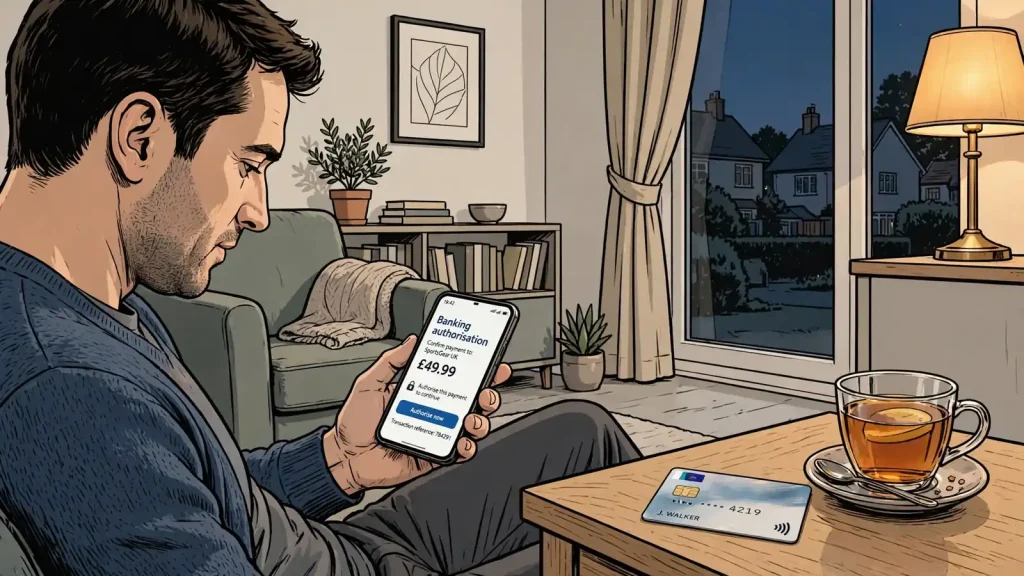
See how bank authentication, payment routing, fees and casino withdrawal support can affect the movement of funds.
How Open Banking Connects a Casino Deposit to Your Bank
An Open Banking deposit is an authorised transfer from your bank account to a casino payment service. Instead of typing card details into a payment form or loading funds into a separate e-wallet, you select a bank-based option and approve access to the payment through your bank. The bank confirms that approval, and the payment service passes the transaction information between your bank and the casino.
The route has distinct parts. The casino cashier presents the available payment options; a payment provider connects to your bank; your bank authenticates you and asks you to approve the payment; then the payment instruction is sent for processing. The casino does not need your online banking password. Authentication takes place through your bank’s own process, such as its app or online banking service. The exact screens and wording depend on the bank and provider.
That distinction matters: a bank-based payment is not simply a card payment with a different label. With a card, you submit card credentials and the card network handles authorisation. With an e-wallet, you first hold a balance with the wallet provider, then instruct it to pay the casino. In an Open Banking flow, you authorise a payment from your bank account through a connection service; there is no separate wallet balance to fund first.
Following the payment from bank to casino
A typical flow begins when you choose the Open Banking option in the cashier and enter the amount. The cashier or its payment provider then directs you to a bank-selection or bank-authentication screen. After you choose your bank, you confirm your identity using the bank’s own security steps and review the payment details. If you approve, your bank sends the payment instruction through the payment service.
The casino then receives confirmation or a status update from its payment provider. A successful authorisation is not the same as the casino receiving every detail of your bank account. The service passes the information needed to identify and reconcile the payment, while your bank remains responsible for authentication and authorisation. If you cancel at the bank stage, fail authentication, or reject the instruction, the deposit may not be completed.
TRON TRX Casino Comparison for UK Players
The route can therefore be understood as a chain of separate decisions: the cashier offers a method, the payment service connects the parties, your bank authenticates you, and you approve the transfer. A pause or failure at any point can prevent the deposit from reaching the casino. This is why a screen that returns you to the cashier does not, by itself, prove that the payment succeeded; the transaction status should be checked there.
Open Banking and bank transfers can support instant deposits and fast withdrawals at many sites, according to a specialist review. That description is not a promise for every casino, bank, payment provider, or transaction. The flow and its status depend on the service the casino makes available and the bank’s handling of the instruction.
What changes compared with a card or wallet
A card payment asks your card issuer to approve a transaction against the card account. An Open Banking payment instead uses your bank’s authentication process to approve a bank payment. You may still see the casino’s payment provider in the process, but you are not handing that provider your bank password; your bank handles the authentication step.
An e-wallet introduces another account between you and the casino. You may need to sign in to that wallet and use its balance or linked funding source. Open Banking does not require that intermediate balance: the payment is authorised against the bank account selected in the flow. The payment provider is still involved, but its role is to connect and relay the payment rather than hold a wallet balance for you.
These routes also differ in the account details they use. A card transaction is associated with the card, and a wallet transaction with the wallet account. With direct banking, the selected bank account is central to the payment. Keeping the account information and payment route in your own name reduces the chance that basic ownership checks will create avoidable friction. A straightforward arrangement is to use one named account consistently for deposits and withdrawals, where the casino supports that route.
Do
- Use a named account that matches your casino profile
- Review the payment screen carefully before approving
- Check the live cashier for current availability and terms
Don’t
- Use someone else’s bank details
- Assume a method works just because it is listed on a general page
- Ignore mismatches between your account name and bank name
This mechanism explains why “direct banking” can describe more than one technical payment arrangement. A cashier might offer an Open Banking connection or a bank transfer, and those are not necessarily identical processes. The label alone does not tell you which provider handles the transaction or how the bank authorisation works. The payment screen’s description is the practical guide to the route being offered.
For Open Banking casinos in the UK, the important point is the hand-off: the casino initiates a payment request, the provider connects it to your bank, and you make the approval through the bank’s authentication process. You remain in control of whether to authorise it. The route avoids entering card details or first funding a separate e-wallet, but it still depends on the casino’s cashier, its payment provider, and the bank account you choose.
Using Open Banking at an Online Casino
Before selecting Open Banking in a casino cashier, confirm that the option is available to your account and that the details you will use belong to you. A payment route appearing on a general information page does not establish that it is available for every customer, at every stage, or with every bank. The cashier is the relevant place to check what you can use for the transaction you are about to make.
Availability may depend on factors such as your account status, location, or the bank connected to your account. If Open Banking is not listed after you sign in, do not assume that a similarly named bank-transfer option works in the same way. Check the casino’s payment instructions or contact its support team to clarify which route is offered and what information it requires. Avoid starting a payment through an unfamiliar link or a third party that is not identified by the casino.
Check your account details first
The name on your casino account should correspond to the name on the bank account you intend to use. Check for differences caused by a typo, an outdated account profile, or a bank account held jointly or by someone else. A mismatch can make it harder to establish who authorised the payment and may lead to questions or a delay while the casino reviews the transaction.
Casinos That Accept Dogecoin in the UK: Payment Guide
Use an account that is yours, rather than another person’s bank details. Keeping ownership information consistent reduces the chance that a basic check interrupts the payment. If your name has changed or your casino profile contains an error, contact the operator and resolve it through the account process before depositing. Do not try to work around a mismatch by entering different details at the bank authorisation stage.
Read the payment screen carefully before you continue. It should identify the casino or payment service involved and show the amount you are authorising. If the bank’s approval page displays a recipient or amount you do not recognise, stop rather than approve it. A payment request should make sense in the context of the deposit you selected.
Confirm the account currency
Check the casino account’s currency before your first transaction. Payment information may state that GBP is supported, but that does not by itself confirm which currency is assigned to your individual account. If your casino balance is held in a different currency from your bank account, a conversion may occur. Confirm the currency shown in your profile or cashier before approving a deposit, so you know whether the amount will be converted.
Also compare the amount shown by the casino with the amount presented for approval by your bank or payment provider. The figures should be consistent with the transaction you initiated. If the payment screen does not explain a difference, pause and ask the casino or provider for clarification instead of assuming that the difference is harmless.
Treat the cashier as the current reference
Payment methods can change, and general payment pages may not reflect the options currently presented to every customer. One specialist review may describe a cashier configuration, but it cannot confirm what is available to your own account now. Verify the option in your signed-in cashier before relying on an external description.
Casinos That Accept Litecoin in the UK: Payments
The same applies to card listings. Visa and Mastercard may appear in payment information, but their presence does not establish that every card product is eligible or that either brand is currently available for your particular transaction. Check the live cashier and its terms. UK-licensed casinos cannot accept credit-card payments for gambling, so do not treat a credit card as an alternative if a debit-card payment is declined. A listed card brand does not override the rules on which card products may be used.
If the cashier offers Open Banking, read any conditions shown beside the option before you proceed. Confirm that the bank you plan to use can be selected, that the displayed payment amount is correct, and that the account belongs to you. If the option is absent, unavailable for your bank, or unclear about the recipient, do not infer eligibility from a list elsewhere. Ask the casino for a clear answer before attempting another route.
Finally, review the casino’s account and payment details as a set: your registered name, the bank account owner, the currency, and the transaction shown for approval. Consistency between these details helps prevent avoidable checks and gives you a clear basis for deciding whether to continue. If anything conflicts, correct it or seek clarification before authorising the deposit.
What Direct Banking Means for Casino Payments
“Direct banking” is a broad label, not a single payment technology. At an online casino, it may refer to an Open Banking payment, a conventional bank transfer or another service that moves funds from a bank account. These routes can all involve your bank, but the steps and parties involved differ. The label alone does not tell you which one the cashier offers.
An Open Banking payment uses a regulated service to connect a payment request with your bank. You authorise the payment through your bank, rather than giving the casino your card number. The service passes the payment instruction between the casino and the bank; it does not turn the transaction into a card payment. This is why an Open Banking option may appear separately from both debit cards and bank transfers in a cashier.
Open Banking
Uses a regulated service to connect a payment request with your bank via authentication.
Bank Transfer
A broad category where money moves between accounts, sometimes coordinated by a service.
Debit Card
Transactions processed through a card network and your card issuer.
A bank transfer is the broader category: money moves between bank accounts. Depending on the arrangement, you may initiate it yourself through online banking or use a payment service that coordinates the transfer. Open Banking can be used to initiate a bank payment, but not every bank transfer uses Open Banking. A cashier’s wording matters, so look for the payment method’s actual instructions rather than assuming that “banking” identifies one fixed process.
How the label differs from other payment routes
With a debit-card payment, you enter or select card details and the payment is processed through the card network. UK casinos commonly accept debit cards, including Visa and Mastercard, although the options shown to you depend on the casino and your card’s eligibility. A card payment is not direct banking simply because the card draws funds from a bank account: the card network and issuer handle the transaction.
An e-wallet is another distinct route. You pay from a balance or payment source held with the wallet provider, which then processes a separate payment to the casino. The casino does not receive the instruction as a direct bank transfer merely because you may have used a bank account to fund the wallet earlier. The wallet sits between your bank and the gambling account.
A prepaid voucher works differently again. It represents prepaid value that you enter at the cashier, rather than a bank payment authorised for that transaction. Cryptocurrency is also separate: it uses a digital asset network rather than a bank transfer or card network. The word “direct” should therefore not be read as a general synonym for every electronic payment.
Casinos That Accept Wirecard in the UK: What to Check
Payment descriptions can be inconsistent between casinos and payment providers. One cashier may call a service “Open Banking”; another may use a provider name or a bank-payment label. Before selecting it, check whether the instructions take you to your bank to authorise a payment, ask you to enter bank-transfer details, or direct you to a separate account or wallet. Those steps help identify the route more reliably than the marketing label.
A specialist review of casino payment pages may group bank transfers, cards, e-wallets and cryptocurrencies in one list, but that does not make them technically equivalent or confirm that every listed method is currently available to every customer. Treat the cashier’s own method description as the practical reference point for the transaction in front of you.
In short, “casino with Open Banking” describes a casino cashier offering a bank-connected payment service; it does not mean that every bank-linked option is Open Banking. Separate the route by who receives your authorisation and how the payment is initiated: through your bank, a card network, a wallet, a voucher system or a cryptocurrency network. This distinction gives the terms a practical meaning without treating “direct banking” as a standardised method name.
Our top casino picks for the UK
- Revery PlayBonus: 100% up to€1,000+ 100 FS · Payout speed: 1-3 business days
- SpinFormulaBonus: 550% Up To £15,000 + 550 FS · Payout speed: 1-3 business days
- BritsinoBonus: Welcome Package – Get your £2,200 + 2,000 FS · Payout speed: 1-3 business days
- ZombillionBonus: Welcome Pack 250% up to £4000 + 200 FS · Payout speed: 1-3 business days
- NightLuckBonus: Welcome Pack + 805% Up To 6400€ + 280 FS · Payout speed: 1-3 business days
- BeOnBetBonus: 100% up to €500 + 100 FS · Payout speed: 1-3 business days
- WinBeastBonus: €5000 + 500 FS + €650 Freebet · Payout speed: 1-3 business days
Deposit Timing, Minimums and Financial Limits
When you make a direct-banking deposit, the time it takes to appear depends on the payment route and the casino’s processing. Open Banking payments and bank transfers are described as capable of delivering instant deposits at many sites, but that is not a guarantee for every transaction. The cashier may show a pending status while the payment is being confirmed; the balance changes only once the casino has received confirmation and credited the funds.
Deposit timing can vary; while many sites offer instant deposits via Open Banking, you should always check the transaction status in the cashier.
A specialist review reports that some sites offer instant deposits through Open Banking or bank transfer. Treat this as a possibility to check against the cashier, not a promise that every casino or account will handle the payment that way. If the balance has not updated, check the transaction status before trying again. Repeating a payment while the first is still processing could leave you with more than one debit.
Check the minimum before opening the payment
The minimum deposit can differ by payment method. A specialist review puts starting thresholds at £10–£20, but that range is not a rule for every casino or every direct-banking option. Read the amount shown in the cashier after selecting the method: a general deposit page may not display the threshold that applies to the particular route.
Compare the minimum with the amount you intend to deposit. If the cashier’s threshold is higher, do not assume that a smaller transfer will be accepted or credited as a partial payment. The payment screen should make the required amount clear before you confirm. If it does not, check the operator’s payment terms or contact support rather than sending funds and relying on a later adjustment.
The same check matters when the cashier offers more than one bank-based route. An Open Banking payment and a manual bank transfer may have different transaction thresholds even at the same casino. Select the actual method first, then review its minimum and any other displayed conditions.
Casinos That Accept Bitcoin in the UK: What to Check
Understand the limits that apply to your account
A casino may set a maximum deposit for a single transaction, a day or a month. These ceilings can differ between payment methods and may also depend on account status. That means a limit shown for one route should not be assumed to apply to another, and a cashier’s displayed maximum may not be the only control affecting what you can deposit.
UK rules also require remote gambling licensees to bring financial limits to a new customer’s attention before the first deposit and to make account-level limit settings accessible. These controls let you set boundaries on your gambling account; they are separate from the payment provider’s own transaction cap. A deposit can therefore be blocked because it exceeds a casino limit, a personal account limit or a payment-method limit.
Before paying, check the amount you are about to send against both the cashier’s thresholds and the limits set on your account. If a payment is declined, do not assume that raising a limit is the right response. First identify which control caused the decline and whether the attempted amount is within the limits you intended to keep. A clear check before confirmation helps prevent an avoidable failed payment or an unintended change to your spending boundary.
Attention A casino limit, a personal account limit, or a payment-method limit can all cause a deposit to be blocked.
Assessing Casino Payment Options Without a Best-Sites List
A payment method’s presence on a casino’s general information page does not prove that it will appear in your account’s cashier. Availability can depend on the operator’s current setup and the payment route offered to you. Before deciding whether a casino suits your needs, open its cashier while signed in and check the options shown for your account. Treat the live cashier as more useful than a broad claim about the best Open Banking casinos.
Then check what the cashier says about the transaction itself. Confirm that the payment is presented as an Open Banking or direct-banking option, note the account currency, and read any fee or conversion information before authorising payment. If the site displays a different currency from your bank account, the amount debited and the amount credited may not match after conversion. Do not infer the cost from the payment method’s name alone.
Compare the total cost, not a headline fee
The overall cost can involve more than a casino charge. Depending on the route, there may also be a payment-provider fee, a fee from your bank or card issuer, a currency-conversion spread, or a network charge. Check the casino’s payment terms and any cost shown in the authorisation flow; where another provider is involved, check its terms as well.
A visible flat fee is only one part of the comparison. A conversion spread is built into the exchange rate rather than necessarily appearing as a separate charge, so it can be easy to overlook and may exceed a stated fee. Compare the likely total for the amount you actually intend to transfer, using the currency and exchange rate that would apply to your transaction.
There is no payment method that can be labelled the cheapest in every case. The result depends on the casino’s charges, the provider’s terms, any bank fees, the exchange rate and network costs. A route with no displayed casino fee can still cost more overall if its conversion rate is less favourable.
Casinos That Accept Diners Club in the UK
Check whether the setup fits your use
For a deposit, look for a clear description of the payment route and any conditions attached to using it. If you want to pay directly from a bank account, an option that requires a separate wallet would not be the same arrangement, even if the wallet is linked to that account. Avoid relying on a site’s headline wording when the cashier describes a different process.
Claims about instant deposits or fast withdrawals should also be treated as conditional, not as a guarantee for every account or transaction. The cashier and payment terms should describe what the site supports; a general claim about speed does not establish how a particular payment will be handled. This matters when assessing new Open Banking casino sites as well as established ones: the relevant detail is the option and its terms in the cashier available to you, not the age or promotional description of the site.
For safety, assess the operator and the payment arrangement separately. A familiar banking flow does not by itself establish that a casino is authorised to serve customers in Great Britain. Remote gambling licensees serving the British market must hold the relevant UK Gambling Commission licence. Check the operator against the Commission’s public register before depositing, and make sure the cashier’s payment instructions are consistent with the account and currency you intend to use.
A useful comparison therefore rests on observable details: the live cashier option, the stated currency, the disclosed charges and conversion terms, and the operator’s regulatory status. That gives you a sounder basis for choosing among Open Banking deposit casinos than an unsupported ranking or a broad promise of speed.
Direct Banking Alongside Other UK Casino Payment Methods
Direct banking is one route in a cashier that may also offer cards, e-wallets, prepaid vouchers or mobile payment services. The labels do not tell you whether each option can be used for both deposits and withdrawals, or whether it is available to your account. Treat the cashier’s current method details as the deciding information.
Casinos That Accept E-Checks in the UK: Payment Guide
A bank-linked payment sends a deposit through a banking service rather than asking you to enter card details or fund a separate wallet first. By contrast, a debit-card payment uses the card network and the eligible card issued to you. UK casinos commonly accept debit cards, but a particular card product may not be eligible at a particular site. Credit-card payments for gambling are not permitted at UK-licensed casinos.
An e-wallet creates an account between your bank and the casino. PayPal is described in specialist reviews as a popular option for speed and convenience, but those reviews also note that its use may affect bonus eligibility. Skrill and Neteller are listed at some sites; specialist reviews report that promotions may exclude them too. Check the terms attached to the specific promotion rather than assuming that a payment method qualifies.
Paysafecard works differently again: it is a prepaid voucher and is deposit-only. That makes it unsuitable as a route for receiving casino funds. Apple Pay is another possible cashier option, with some UKGC-licensed casinos accepting it for deposits. Its presence does not, by itself, establish that it supports payouts.
These alternatives are not interchangeable. A wallet can add a separate account and its own eligibility rules; a voucher is limited to depositing; a card depends on the product and cashier; and a bank-linked route depends on the banking service offered by the site. The relevant choice is therefore not simply “direct banking versus cards”. It is which methods the casino makes available to you, for the transaction you intend to make, and under what conditions.
For a direct banking casino in the UK, compare the cashier’s available options with the casino’s payment terms and any promotion rules. Do not infer withdrawal support from a deposit button or assume that a method listed on another site will appear in your account. Method availability and eligibility can differ between casinos and customers.
Check Deposit and Withdrawal Support Before You Pay
A payment option displayed in a casino cashier is not automatically available for both directions. A method may accept deposits but not withdrawals, or the cashier may offer different choices depending on your account. Before sending money, check the terms attached to that specific method rather than inferring withdrawal support from its presence in the deposit menu.
Check withdrawal support
Before depositing, confirm if your chosen method supports withdrawals, as some options may only be intended for adding funds. Check the specific terms for your account to see if the payout route requires different information or verification.
For an Open Banking casino payment method, look for separate information about deposits and cash-outs. If the cashier describes Open Banking only as a way to add funds, ask the operator whether it can also receive withdrawals. The same check applies when a casino advertises an instant banking deposit: “instant” describes the deposit service, not necessarily the route or speed for a payout.
Where withdrawal support is available, confirm what account the casino will send the money to and whether the name must match your gambling account. If the cashier requires a different withdrawal method, check its instructions before depositing; changing the route later can mean extra steps. Do not treat a payment brand as evidence that every casino uses it in the same way.
Availability varies by operator. Some UKGC-licensed casinos accept Apple Pay for deposits, but that does not establish that Apple Pay is available for withdrawals. A specialist review of UK casino payment options describes Skrill as a common deposit choice at UK-facing sites in 2026; that observation is not proof of withdrawal support at a particular casino. A specialist review also reports Jeton at a small number of UK online casinos in 2026, but you still need to confirm its current cashier listing and whether the listed function covers deposits, withdrawals, or both.
A useful cashier check is therefore specific: find the method under the deposit heading, then locate it separately under withdrawals or read the operator’s payment terms. If the payout route is unclear, contact customer support before depositing and keep the response. This prevents you from choosing a deposit method on the assumption that it also provides an instant withdrawal route.
Casinos That Accept Boku in the UK: What to Check
Bank Transfers, Currency and the Full Cost of a Transaction
The amount you initiate is not always the amount that reaches a casino account or returns to your bank. The difference can come from the currency used, the exchange rate applied, or charges taken at different points in the payment chain. To assess the full cost of a direct banking transaction, check each point rather than looking only for a casino fee.
Start with the account currency shown in the cashier or your account settings. A specialist review of casino payment arrangements reports GBP support on the pages it examined, but that does not establish the currency for every account or transaction. Confirm yours before paying. If the casino account and your bank account use different currencies, conversion may take place, and the exchange rate can include a spread: the rate applied may be less favourable than a reference rate, reducing the credited amount or the amount received.
Fees can arise from the casino, the payment provider, your bank or card issuer, and, where relevant, the payment network. Which party charges what depends on the route and transaction. A fee may be deducted before the funds arrive, or charged separately. Read the cashier terms and any confirmation screen, then check your bank’s tariff and the provider’s terms. A visible flat fee is not the whole comparison: conversion spread can cost more, so compare the final amount in the currency you will actually use.
Why might the credited amount differ from my deposit?
Differences can arise from currency conversion spreads, bank fees, or provider charges applied during the transaction chain.
Does a fast deposit mean a fast withdrawal?
Not necessarily; while a deposit might be instant, withdrawals must first pass the casino’s internal approval and verification stages.
Timing and value are linked when a transfer crosses currencies. A specialist review of transfer arrangements identifies cut-off times, weekends and currency conversion as factors that can affect delivery. A request made outside a bank’s processing window, or around a weekend, may take longer to complete; conversion can also affect when the final amount is determined. Check whether the displayed figure is the amount sent, the estimated amount converted, or the amount expected to be credited.
For a direct banking casino deposit, treat the payment confirmation as a record of the initiated amount, not proof of the final credited amount. Keep the casino receipt and your bank entry, then compare the transaction currency, applied rate and any separate fees if the figures differ. This makes the source of a discrepancy easier to identify without assuming the casino alone set the final cost.
Why a Fast Deposit Does Not Guarantee a Fast Withdrawal
A direct-banking deposit and a withdrawal follow different processes. A deposit may reach the casino quickly, but a payout must first pass the casino’s internal approval stage. Only after approval can the payment provider begin sending the funds to your bank. A fast incoming payment therefore does not establish how quickly a withdrawal will be completed.
The total wait has at least two parts: the time the casino takes to review and release the request, and the time the provider takes to deliver it. The first part is controlled by the casino; the second depends on the payment route and provider. An instant-banking withdrawal is not necessarily instant from the moment you request it, because the approval stage comes first.
Verification can add time before release. The casino may need to confirm that your account is fully verified, and a first withdrawal can take longer if checks are still outstanding. If information or documents are requested, the request may remain under review until the casino has what it needs. Completing KYC before requesting a payout can reduce the chance of a verification check becoming an unexpected pause, but it does not remove the casino’s approval process or determine the provider’s delivery time.
A specialist review may describe Open Banking or bank transfers as supporting fast withdrawals, but that should not be read as a fixed turnaround for every casino or account. Check the casino’s stated processing conditions and distinguish the approval period from the payment provider’s transfer time. When estimating when funds may arrive, use the slower stage as the practical constraint: a rapid transfer cannot compensate for a request that has not yet been approved.
How Withdrawal Routing and Verification Affect Your Funds
When you request a withdrawal, a casino may return money through the payment source used to deposit. UK anti-money laundering rules generally require payouts to go back to that original source. This is part of closed-loop rules: keeping funds moving between accounts with a clear link to the customer helps reduce opportunities for fraud and money laundering.
With direct banking, the relevant source may be the bank account or payment route connected to the deposit. Using the same account details for both directions can make ownership easier to establish. If you request payment to a different account or method, the casino may need to check that you own it and that the change is legitimate. An alternative route can therefore involve extra verification rather than an immediate transfer.
Before depositing, check which account will be treated as the payment source and whether the casino’s cashier sets out a different process for withdrawals. Make sure the account details you provide belong to you and are consistent across the casino account and payment service. A mismatch can create avoidable questions when you later ask for your balance.
These checks do not mean that a withdrawal will always use the same technical route as a deposit. The casino’s payment rules and the requirements of the provider determine the available path. If the original method cannot receive a payout, contact the casino before choosing another route; changing it without confirmation may delay the ownership checks.
Why must withdrawals return to the deposit method?
Returning funds to the original payment source is a common anti-fraud and anti-money-laundering control. Using a different route may require extra verification.
What is the fastest withdrawal method for UK casinos?
PayPal, Open Banking services and debit cards connected to fast payout systems are generally among the quickest options. Your account’s verification status and the casino’s approval process also affect how quickly you receive funds.
Which payment methods are accepted in Great Britain?
UK casinos commonly accept Visa and Mastercard debit cards, and some also offer bank transfers, Open Banking, PayPal, Skrill, Neteller, Paysafecard or Apple Pay. Check the cashier for the methods available to your account.
Can I deposit in GBP?
Yes, GBP is supported. Check that your account is set to GBP before depositing to avoid currency conversion.
Which method has the lowest fees?
There is no universally cheapest method. Compare any casino and provider charges, bank or issuer fees, currency-conversion spread and network costs for your payment.
Are Visa and Mastercard deposits definitely debit cards?
No. Visa and Mastercard are listed, but you should check the cashier to confirm that your particular card product is eligible; credit card gambling is banned in the UK.