

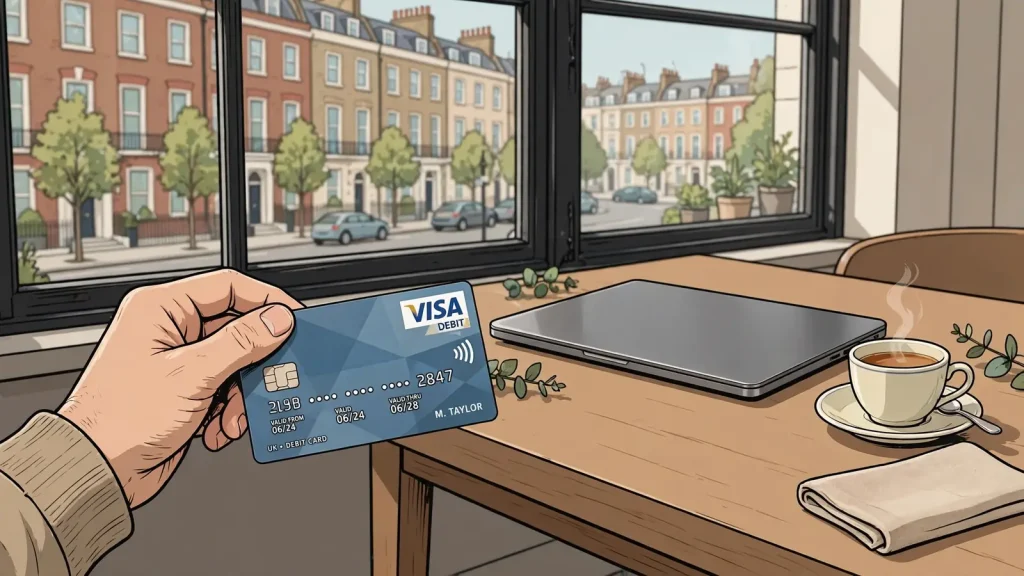
Find out how casino card acceptance, deposits, withdrawals, payment timing and limits can affect your choice of payment route.
How Debit Card Deposits Work at UK Casinos
You can use a debit card to fund an account at many UK online casinos. Visa and Mastercard are commonly accepted, but that does not mean every card carrying one of those logos will work at every casino. Your card must be a debit product, and the casino must support it for your account. The cashier is where you can confirm the options available to you.
A debit card takes money from the bank account linked to it. When you enter your card details and submit a deposit, the payment is handled as a card transaction rather than a credit advance. That distinction matters: UK rules allow debit-card deposits for gambling, but prohibit credit-card payments for gambling.
The regulator introduced the credit-card ban on 14 April 2020, and it remains in force. A credit card cannot be used to deposit at a UK-licensed casino, even if the card is accepted for other purchases. Nor can a payment be routed through a money service or wallet to get around the restriction when credit-card funds are involved. If your card account combines features, check whether the specific product is treated as a debit card before attempting a deposit.
So, if you are asking whether you can deposit at an online casino with a debit card in the UK, the general answer is yes: Visa and Mastercard debit cards are widely used for this purpose. The important boundary is the funding source. A debit card draws on your own available bank balance; a credit card borrows money, and credit-card payments for gambling are not permitted.
This distinction establishes what “card deposit” means in this guide: a permitted debit-card payment, not a credit-card transaction. Individual card products and casino cashiers can differ, so the logo alone is not confirmation that your particular card is eligible.
Our top casino picks for the UK
- Revery PlayBonus: 100% up to€1,000+ 100 FS · Payout speed: 1-3 business days
- SpinFormulaBonus: 550% Up To £15,000 + 550 FS · Payout speed: 1-3 business days
- BritsinoBonus: Welcome Package – Get your £2,200 + 2,000 FS · Payout speed: 1-3 business days
- ZombillionBonus: Welcome Pack 250% up to £4000 + 200 FS · Payout speed: 1-3 business days
- NightLuckBonus: Welcome Pack + 805% Up To 6400€ + 280 FS · Payout speed: 1-3 business days
- BeOnBetBonus: 100% up to €500 + 100 FS · Payout speed: 1-3 business days
- WinBeastBonus: €5000 + 500 FS + €650 Freebet · Payout speed: 1-3 business days
Checking Whether a Casino Accepts Your Card
A casino may list Visa and Mastercard without accepting every card issued under those schemes. The logo identifies the card network, not the product type, issuer rules or whether the operator’s payment provider can process your particular card. To check eligibility, use the cashier on the casino account you intend to use. A general payment page can describe the methods the operator offers, but the cashier is where you can see which options are available to your account.
Casinos That Accept Wirecard in the UK: What to Check
Check the cashier, not just the payment page
Sign in and open the deposit area of the cashier. Look for a card option that names Visa or Mastercard, then check whether the form allows you to select it and enter your card details. Availability can depend on the account, so a logo elsewhere on the site is not confirmation that the method is enabled for you.
If the card option is absent, do not assume that a card with the relevant logo will work through another route. Ask the operator’s support team whether your card product is eligible and whether the cashier is expected to show the option. This is particularly useful if a general payment page lists card support but your signed-in cashier does not.
Treat the cashier as a practical check, not as permission to use a credit card. UK-licensed casinos cannot accept credit-card payments for gambling, including credit-card funding routed through a money service business. The card must be a permitted debit product, and the payment must be made directly through an accepted route. A digital wallet is not a workaround where it allows credit-card funds to be used for gambling.
Identify the card product
Check your banking app or ask your issuer what type of card you hold. Some cards may display a familiar network logo while having product features or restrictions that affect gambling transactions. The casino’s listed network alone does not tell you how the issuer classifies the card or whether the issuer permits the transaction.
Use a card issued in your own name and make sure the account details you give the casino match the details held by your bank. Matching ownership information reduces the chance of avoidable questions about who controls the casino account and payment method. If the card is joint, business, prepaid or otherwise not straightforward, check with both the operator and issuer rather than relying on the logo.
DO
- Check the cashier to confirm your specific card is enabled
- Ask the operator’s support team if your card product is eligible
- Use a card issued in your own name
- Ensure account details match your bank details
DON’T
- Test an uncertain card by entering details repeatedly
- Share your full card number or security code with support
- Assume a logo on the site confirms your card works
- Use a card that is not a permitted debit product
Do not test an uncertain card by entering details repeatedly. A declined transaction may leave you unsure whether the cause is the card product, the issuer, a detail entered incorrectly or an operator-side restriction. Confirm the card’s status with the issuer and ask the casino which card products its cashier accepts. Never share a full card number, security code or one-time banking code with support.
Confirm the account and currency
Before making a deposit, check that the casino account is registered to you and that its payment details are yours. Operators must verify a customer’s age before allowing a deposit, and they may also need to confirm account information. Use accurate details from the start; inconsistent names or address information can complicate an eligibility check.
Check the account currency before the first transaction as well. Casino information may indicate that GBP is supported, but that does not prove your particular account is set to pounds. Confirm the selected currency in the cashier or account settings. If it is not GBP, pause and ask the operator whether the account currency can be changed before you proceed. This keeps the card-acceptance check separate from an unplanned currency conversion.
A payment option can also be shown but unavailable for a particular account. If the cashier displays a message or asks you to complete an account check, follow the operator’s instructions or contact support. Do not infer from another player’s experience that the same card product will be accepted on your account: issuers, card types and account eligibility can differ.
Use a short eligibility check
Before relying on a casino for card deposits, verify these points in order:
- The casino is a UK Gambling Commission-licensed operator. Remote gambling licensees serving the British market must hold the relevant UK licence; you can check its current status on the Commission’s public register.
- The signed-in cashier displays Visa or Mastercard as a deposit method for your account.
- Your issuer confirms that the card is a debit card and permits the transaction.
- The card and casino account belong to the same customer, with matching personal details.
- The account currency is set as you intend before you make the first transaction.
If any point is unclear, ask the operator a precise question: whether the exact type of debit card you hold is accepted for deposits through its current cashier. A generic answer that the casino “accepts Visa” may only confirm network support; it may not resolve whether your particular card product is eligible. Check the answer against what your account actually displays, and do not proceed if the cashier or operator cannot clarify the restriction.
This process helps distinguish three separate issues: whether the casino offers card deposits, whether your account can access that option, and whether your specific debit card is eligible. All three need to align before the card can be used.
Deposits, Withdrawals and Returning Funds to Your Card
A debit-card deposit and a withdrawal are separate transactions, even when both relate to the same casino account. The deposit sends money from your card account to the casino. A withdrawal is a new payment in the opposite direction, subject to the casino’s checks and the rules governing where gambling funds can be returned. That is why a successful online casino deposit with a debit card does not, by itself, confirm how a later payout will be handled.
A successful deposit with a debit card does not guarantee how a future withdrawal will be handled, as payout rules and methods may differ.
Why a withdrawal may go back to the card
UK anti-money laundering rules generally require a casino to return funds to the original payment source. This is part of the closed-loop approach to payments: money should travel back through a source associated with the customer, rather than being redirected to an unrelated person or account. If you deposit with a Visa debit card, the casino may therefore route an eligible withdrawal back to that card.
The card number shown for a deposit is not always the detail used to deliver a refund or payout. Card providers can process a return through the card account even where the number displayed on a replacement card differs. The casino and its payment provider determine whether the original card route can still receive the funds. If the card has expired, been replaced or is no longer usable, contact the casino before choosing another destination. It may need to check the account and explain which alternative route it can accept.
Returning funds to the original source is also an anti-fraud control. Sending a payout to a different payment account can make it harder to establish who funded the gambling account and who is receiving the money. An alternative destination may therefore require additional checks. Do not assume that you can deposit with one method and freely select another for withdrawal.
Keeping the casino account and payment route in your own name helps avoid basic ownership mismatches. If the casino’s account details do not correspond with the cardholder or payment account, a transaction may need clarification before it can proceed. Use your own payment instrument and enter account details accurately; another person’s card is not a suitable workaround.
Casinos That Accept Bitcoin in the UK: What to Check
What happens between requesting and receiving a payout
A withdrawal request starts a process; it does not mean that the money has already reached your bank. The casino first handles the request within its own system. It may review the account and confirm that the withdrawal can be released. After approval, the payment is passed to the relevant provider or card network, then processed towards your card account. These are distinct stages, so a status such as “requested” or “pending” does not mean the same thing as “sent” or “received.”
A card payment into a casino can be instant, while a payout to the same debit card can take several business days. The two directions do not use identical processing paths. A deposit may be authorised at the point of payment, whereas a withdrawal must pass through the casino’s approval process before an outgoing payment is initiated. The receiving bank or card provider then has its own part in completing the transfer.
The time shown by a casino may describe only one stage. For example, an estimate may refer to the casino’s handling, the payment provider’s processing, or the overall period until the funds appear in your account. Check what the stated status or estimate means rather than treating every stage as completed at once. If the casino marks a withdrawal as paid, that may indicate it has sent the payment; it does not necessarily mean your bank has already posted it.
Why payouts might be delayed
First withdrawals can take longer due to identity or payment checks (KYC). A request for documents can pause progress until the casino has reviewed the information.
First withdrawals can take longer when identity or payment checks still need to be completed. KYC is part of establishing that the account belongs to the customer and that the payment route is consistent with the account details. A request for documents or clarification can pause progress until the casino has reviewed the information. Completing verification before requesting a withdrawal can reduce the chance of a delay caused by outstanding checks, but it does not remove the casino’s need to review a particular payment.
If the original card cannot receive the money
A closed or replaced card does not automatically mean that a payout can be sent to any account you choose. The casino may need to confirm what happened to the card and whether the linked bank account can still receive a return. Follow the casino’s instructions and provide the requested information through its account or support channels. Avoid submitting repeated withdrawal requests to different destinations while the original request is unresolved; multiple routes can complicate the review.
If the casino says the card route cannot be used, ask what approved alternative is available and whether additional verification is required. Any replacement route should belong to you and match the account information held by the casino. This supports the same ownership checks that apply to the original deposit route.
You can also ask the casino to clarify the withdrawal’s current stage: whether it is awaiting internal approval, has been sent to the payment provider, or is awaiting posting by your bank. That distinction helps identify where to direct a follow-up. If the casino has released the payment, the remaining wait may sit outside its own processing system; if it is still under review, ask whether any information is needed from you.
Casinos That Accept Instadebit in the UK: How to Check
For a debit card online casino transaction, the practical point is that the deposit method and payout method are linked, but they are not mirror-image transactions. The original card may be the required return route, and the withdrawal has its own approval and delivery stages. Treat the cashier’s withdrawal instructions as part of the payment route, not as a simple reversal of the deposit.
What Can Change Payment Speed and Cost
A withdrawal’s arrival time is not determined by the debit card alone. The casino first has to review and approve the request; the payment provider and card issuer then have their own processes. A specialist review identifies internal approval and account verification as factors that can change withdrawal speed, but those timings are not a fixed property of every casino or card.
Internal review and verification
The casino’s internal stage can affect the total wait before money is sent. If your account is not fully verified, KYC checks may need to be completed before a withdrawal is approved. This can add a separate step, particularly when verification is still outstanding. Once the casino has approved the request, the card provider and issuer still determine how the incoming payment is handled.
That is why a quick deposit does not establish how quickly a withdrawal will arrive. The two transactions pass through different checks and processing stages. When comparing online casinos that accept debit cards, look at the stated withdrawal process as well as the deposit method; do not infer payout timing from how quickly a card deposit appears.
Withdrawal Speed
Total wait time is determined by the casino’s internal review, the payment provider, and the card issuer, not just the debit card itself.
Where fees can arise
The total cost may involve more than a charge shown by the casino. Possible components include a casino fee, a payment-provider fee, a fee from your bank or card issuer, currency conversion, and network charges. Which components apply depends on the route and the transaction. A casino may charge nothing while another party involved in the payment still applies a fee.
Before you confirm a transaction, check the casino’s payment terms and any charge information supplied by the provider or your bank. The point is to identify each possible charge, not to assume that a “free” label from one party covers the entire route. If a fee is described as a fixed amount, compare it with the other costs that may apply to the same transaction.
Currency conversion can hide a cost
The currency used for your casino account and the currency attached to your card or bank account may differ. If they do, a conversion can take place, and the exchange rate may include a spread: the difference between the rate applied to the transaction and a reference rate. A conversion spread can cost more than a visible flat fee, so a payment with no stated charge is not necessarily the lowest-cost option.
Check the account currency before transacting and note who performs the conversion. If the casino, provider, or card issuer converts the funds, the applicable rate may differ. Where a payment route supports pounds sterling, confirm that your account is actually set to that currency; otherwise, conversion may still occur. For a fair comparison, assess the amount that will be debited or credited after conversion, not just the exchange rate displayed in isolation.
Casinos That Accept iDEAL in the UK: How to Check
Compare the full transaction
There is no single payment method that is cheapest in every case. The result depends on the casino’s charge, any provider or bank fees, conversion spread, and network cost for the particular amount and route. A flat fee is easy to spot, while a spread may be built into the exchange rate. Both belong in the comparison.
For a debit-card withdrawal, check whether the casino lists a charge, whether your issuer may apply one, and whether the transaction involves currency conversion. For another payment route, make the same checks with its provider and any bank involved. Compare like with like: the same currency, transaction direction, and amount. Otherwise, a lower visible fee may simply conceal a cost elsewhere in the process.
If the casino’s terms do not make a charge clear, ask the operator before submitting the request. Keep the response and the transaction record so you can compare the stated cost with the amount that reaches your account. This is more useful than relying on broad claims that a particular debit-card casino or payment method is free or fast: approval, verification, provider handling, and conversion can all change the outcome.
Deposit Limits and Financial Controls
When you open a debit card casino account, the amount you can add is shaped by two separate controls: the casino’s transaction limits and your own financial limits. The first set determines what the cashier will accept. The second lets you restrict how much you deposit over time. They serve different purposes, so changing one does not necessarily change the other.
Financial Controls
- Check the minimum deposit amount in the cashier
- Confirm the maximum transaction limit allowed
- Set a personal financial limit before your first deposit
- Verify your account’s daily or monthly deposit limits
Minimums and maximums
A casino sets a minimum deposit for each payment method. A specialist review may report minimums in the £10–£20 range, but that is not a fixed UK-wide rule: the amount shown in your cashier is the one that applies to your account and chosen method. A card option may have a different minimum from another route at the same casino.
Maximums can also depend on the method and your account status. The cashier may apply a cap to a single transaction, while separate daily or monthly limits govern the total you can deposit across multiple payments. Account-level checks can affect which maximum is available to you. Do not assume that a limit shown in general payment information applies to every customer or remains unchanged after your account details are reviewed.
Check the amount before confirming a deposit. If the cashier rejects it, read the displayed limit and adjust the amount rather than repeatedly resubmitting the same transaction. Keep track of your own deposits as well: a per-transaction ceiling does not tell you how much you have added over a day or month.
The required prompt before your first deposit
UK Gambling Commission rules require a remote gambling operator to ask new customers to set a financial limit before they make their first deposit. The operator must also provide account-level controls that you can access later. This makes setting a limit part of opening and using an account, not an optional feature hidden in payment terms.
Read the prompt carefully and choose an amount that reflects what you can afford to lose. A limit is a boundary for deposits, not a target to reach. If you set one, check which period it covers and how the account displays your remaining allowance. The operator’s wording and interface will show how that particular control works.
Managing account limits
Use the account controls to review or change your limit when your circumstances change. A limit may apply to deposits rather than total gambling activity, so do not treat it as a complete measure of spending or losses. Keep your own records if you need a clearer view of what you have paid in.
If you want to reduce a limit, use the available account controls and follow the operator’s confirmation steps. For an increase, the operator may apply a delay before the higher limit takes effect; check the terms shown in your account rather than assuming a change is immediate. Until it takes effect, the existing restriction may continue to apply.
A deposit limit is distinct from a card’s own spending controls and from any separate account restriction. If a payment is declined, check the cashier’s limit and your account settings before changing either. The aim is to know which control is preventing the deposit, without raising a limit simply to make a payment go through.
Choosing a Payment Route That Fits Your Needs
A payment method is not just a way to put money into a casino account. It also affects whether you can withdraw through the same route, whether a promotion accepts the deposit, and whether the method fits how you manage your funds. Compare those conditions in the cashier and the relevant terms before choosing.
PayPal
Useful for speed and convenience using a separate payment account. Note that some casinos may exclude PayPal from bonus eligibility.
Open Banking
Connects directly to your bank account for potentially instant deposits and fast withdrawals.
E-wallets
Services like Skrill or Neteller provide a separate balance, though they are often excluded from promotions.
Debit cards
Visa and Mastercard debit cards are familiar options for deposits. They can suit you if you want to pay directly from a bank account and keep transactions connected to one named account. A card deposit can arrive immediately, but that does not mean a withdrawal will reach the card at the same pace. Casino processing and the payout route affect that separately.
Check the cashier for the specific card and account eligibility, then read the withdrawal terms. A casino may list a card brand without accepting every card product that carries its logo. Keeping the casino account and payment method in your own name also reduces avoidable ownership checks.
PayPal
PayPal can be useful if you prefer a separate payment account and value its speed and convenience. However, do not assume a PayPal deposit qualifies for a promotion. A specialist review has reported that some casinos exclude PayPal payments from bonus eligibility; the casino’s own promotion terms are the deciding source for your particular offer.
Confirm that the cashier supports PayPal for the transaction you intend to make, and check whether it is available for both deposits and withdrawals. The payment route shown for deposits does not by itself establish the payout arrangements.
Open banking and bank transfers
Open banking services connect a payment to your bank account, while a bank transfer sends funds through the banking system. They may be suitable if you want the transaction to originate directly from your bank rather than a card or wallet. A specialist review has described open banking and bank transfers as providing instant deposits and fast withdrawals at many sites, but availability and timing depend on the individual casino and service.
For transfers, check which account details and instructions the cashier provides. If a payout is involved, the casino may require the same account to be used or may request additional checks before allowing another route. Confirm the supported deposit and withdrawal functions rather than inferring one from the other.
Prepaid vouchers
Paysafecard is a prepaid voucher for deposits only. It may help you keep a casino payment separate from your bank card, but it is not a route for receiving winnings. Before choosing it, make sure you have another supported method for withdrawals and understand how the casino handles a payout when the original deposit came from a deposit-only method.
E-wallets
Skrill and Neteller are offered by some casinos. They can provide a separate balance for gambling transactions, but a specialist review has noted that these wallets are often excluded from promotions. Check the conditions of each offer before depositing, as eligibility can depend on the payment method rather than only on the game or account.
Some specialist coverage also describes Skrill as a common deposit option at UK-facing casinos, while Jeton is reported at only a small number of UK casino sites in 2026. Neither point establishes that a method is available at a particular casino: use its cashier to confirm access and whether withdrawals are supported. EcoPayz changed its name to Payz in 2022, so look for the current brand if you are checking older payment information.
Casino Sites That Accept Jeton in the UK
Compare the whole route
A practical choice accounts for the deposit, any withdrawal, and promotion rules together. If you select a deposit-only voucher, plan a separate payout method. If you use a wallet, verify the offer’s payment exclusions. If you use a card or bank-linked method, confirm the casino’s withdrawal conditions and keep the account details consistent.
The cashier and terms should answer three separate questions: can you deposit with this method, can you withdraw through it, and does using it affect bonus eligibility? A method that meets only the first condition may not fit the way you intend to manage the account.
Are Visa and Mastercard deposits definitely debit cards?
No. Visa and Mastercard identify the card network, not whether your card is a debit or credit product; check your card with your issuer and confirm that the casino cashier accepts it.
Are fast casino withdrawals guaranteed?
No. Payout speed depends on the casino’s approval process, your verification status and the payment method; card deposits can be instant while withdrawals take several business days.
Which payment methods are listed for 333 Casino?
The listed methods include Visa, Mastercard, bank transfer, e-wallets and several cryptocurrencies.
Why must withdrawals return to the deposit method?
Returning winnings to the original payment source is a common anti-fraud and anti-money-laundering control. Using the same account for deposits and withdrawals can also reduce avoidable ownership checks.
Can I use a credit card at 333 Casino in Great Britain?
No. UK-licensed casinos cannot accept credit-card payments for gambling, and routing credit-card funds through a money service or wallet does not make them permissible.