

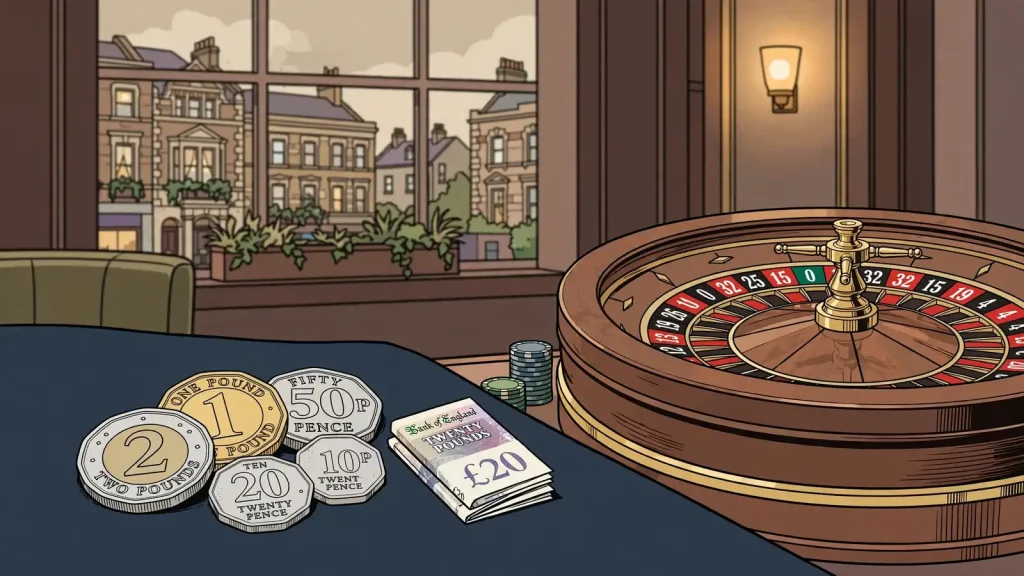
A £4 minimum applies to a specific account or payment route, not necessarily every way to deposit at a UK casino.
How a £4 Deposit Fits into UK Casino Minimums
A £4 minimum deposit means the cashier will accept a deposit of four pounds as the smallest amount for the relevant account or payment route. It does not mean that every way of paying into that account has the same floor, or that four pounds is a standard minimum across UK casinos. The figure describes what the cashier permits under the terms shown for that operator; it is not a general market rule.
That distinction matters because casino minimums cover several different thresholds. An operator may set an account-wide minimum, while a particular payment option has its own lower limit on the amount it can process. The cashier may then show the amount currently available for the method you selected. A £4 option therefore says something precise about that transaction path, but not necessarily about every method offered by the casino.
Across the UK market, the stated minimums span a wider range. Some casinos accept deposits from £1, while a specialist review reported £10 as the typical minimum among UK casinos accepting direct banking, with some operators using £5 or £20 instead. These figures are not interchangeable: the first describes the lower end of available deposit thresholds, while the second concerns a specific payment category. A £4 minimum sits above the reported £1 floor and below those direct-banking examples.
The £1 end of the range is limited rather than representative. A specialist review identified six UK Gambling Commission-licensed casinos as accepting genuine £1 minimum deposits, and its listed set named NetBet as the only UKGC-listed casino with that cashier minimum. Treat that as a snapshot of the reviewed list, not a permanent count or a guarantee about what a cashier will display now. Minimums can differ between operators and may change, so a figure reported elsewhere cannot replace the amount shown in the account you are using.
£5 Minimum Deposit Casinos in the UK: What to Check
What the £4 figure does—and does not—tell you
If a cashier accepts £4, the amount is enough to meet that displayed minimum for the selected route. It does not establish that £4 is the smallest possible deposit at the casino overall: another permitted method may have a lower threshold. Nor does a casino that accepts £1 necessarily accept £4 through every route; the payment option selected can affect what the cashier permits.
The number also does not indicate how much you must deposit to qualify for a promotion, how much you can withdraw, or what you can do with the balance once it is in the account. Those are separate rules. For a comparison of minimum deposits, keep the question narrow: what is the smallest amount the cashier currently accepts for the route you intend to use? Other thresholds answer different questions and should not be read into the deposit minimum.
This is why a £4 minimum deposit casino is best understood as a practical price point, not as a special category with uniform rules. Two casinos displaying the same minimum may differ in available payment routes and account terms. Conversely, an operator whose general minimum is higher may show a different floor for a particular route. The amount is useful only alongside the context in which it is offered.
Anjouan Casino Licence in the UK: What It Means
For a quick comparison, place £4 between the lower and higher thresholds rather than treating it as a market average. Some UK casinos go down to £1; the reviewed direct-banking examples include £5, £10 and £20, with £10 described by that specialist review as typical for that category. A £4 cashier minimum is therefore lower than many of those direct-banking figures, but higher than the smallest reported casino deposits. This describes where the amount falls within the available range; it does not predict which operators will accept it.
The phrase “minimum deposit” can also be ambiguous unless you identify whose minimum is being discussed. It may refer to the casino’s general cashier setting, the floor attached to one payment option, or the smallest deposit that meets a separate condition. For a £4 transaction, only the first two determine whether the cashier will let you proceed. The decisive detail is the amount displayed for the selected route at the time you deposit.
A £4 minimum deposit describes what the cashier permits for a specific transaction path, but it does not mean that every payment method offered by the casino has the same floor.
A low threshold can make a casino accessible with a small initial payment, but it does not make the casino’s other terms equally low. Keep the £4 figure attached to its exact meaning: the least the cashier accepts in the stated circumstances. Once that is clear, comparisons with £1, £5, £10 or £20 thresholds become more useful, because each amount can be understood as a different operator setting rather than a promise about the whole account.
Our top casino picks for the UK
- Revery PlayBonus: 100% up to€1,000+ 100 FS · Payout speed: 1-3 business days
- SpinFormulaBonus: 550% Up To £15,000 + 550 FS · Payout speed: 1-3 business days
- BritsinoBonus: Welcome Package – Get your £2,200 + 2,000 FS · Payout speed: 1-3 business days
- ZombillionBonus: Welcome Pack 250% up to £4000 + 200 FS · Payout speed: 1-3 business days
- NightLuckBonus: Welcome Pack + 805% Up To 6400€ + 280 FS · Payout speed: 1-3 business days
- BeOnBetBonus: 100% up to €500 + 100 FS · Payout speed: 1-3 business days
- WinBeastBonus: €5000 + 500 FS + €650 Freebet · Payout speed: 1-3 business days
What £4 Can Cover When You Play Slots
A £4 balance is best understood as a set of individual stakes, not as a fixed amount of playing time. Each spin deducts the bet you choose; a win may add money back, while a losing spin reduces the balance. The result therefore depends on the stake, the outcomes and whether you change your bet as you play.
Many online slots accept stakes of £0.10 to £0.20 per spin. At those amounts, a £4 starting balance would cover 40 spins at £0.10 each or 20 at £0.20 each if every spin lost and you made no other changes. These are arithmetic comparisons, not a prediction of how long a session will last: wins can extend play, and higher stakes use the balance more quickly.
How stake size changes the number of spins
The calculation is straightforward: divide the balance by the stake per spin. At ten pence, four pounds contains forty stake units; at twenty pence, it contains twenty. If a game offers a stake between those amounts, the number of full spins falls between those totals.
Choosing a Casino: UK Options and Key Considerations
That count assumes the entire balance is available for stakes and that each spin costs the same. In actual play, a win changes the amount left in the account, and you may raise or lower the stake. Some games also show several bet settings, so check the total cost displayed before spinning rather than relying on a single coin or line value. The amount shown as the total bet is what matters for this calculation.
A useful way to set a pace is to decide how many spins you are prepared to fund before opening the game, then divide the available balance by that number. This does not make the balance last for a guaranteed period: it sets a stake ceiling for each spin. If the game’s lowest available total bet is above the amount you chose, select another stake setting or another game rather than assuming the displayed small denomination is the full cost.
Why the same balance can feel different
A £4 balance can support more spins at a low stake than at a higher one, but the number of spins is not the same as the chance of a particular result. Slot outcomes vary from spin to spin. A run of losses can use the balance rapidly even at a modest stake; a win may return part of what was wagered, but it does not guarantee that the next spins will be funded.
For that reason, count each spin as money exposed to the game, not as a purchase of a fixed amount of entertainment. If you raise the bet after a loss, the remaining balance covers fewer spins. If you lower it, the same balance can cover more individual bets, although the outcome of each spin remains uncertain. Keeping the stake constant makes it easier to see how quickly the balance is being used.
Minimum Deposit £4 (depending on the route)
Typical Direct Banking Minimum £10
Lowest Reported Minimum £1
The game name does not change this basic arithmetic. Gates of Olympus and Mega Moolah can serve as examples of slots to inspect, but their names alone do not tell you what a selected spin will cost. Check the bet controls inside the game and confirm the total stake before play. If the available setting does not fit your planned spend, do not treat the title as suitable merely because the deposit is small.
Set a limit before playing
Before your first deposit, set a financial limit in the account controls and keep the stake within the amount you are willing to lose. A £4 deposit is not a reason to increase the bet to make the balance feel more substantial. If you choose a low stake, the balance may fund more spins; if you choose a higher one, it may be used in fewer. Neither choice makes a win more certain.
Online slot play in Britain has further operating limits: spins must last at least 2.5 seconds, and autoplay is not allowed. That means a simple calculation of spins does not translate directly into a guaranteed session length. The time between spins, the pace at which you choose to play and the results all affect how long the balance remains in use.
Treat the displayed stake as the cost of one spin, and recalculate whenever you change it. This gives you a practical way to judge whether a game’s settings fit a £4 balance without assuming that the balance will last for a particular number of minutes or produce a return.
£2 Minimum Deposit Casinos in the UK: How It Works
What Happens After You Deposit £4
Once a £4 deposit is accepted, the money is recorded in your casino account balance. That does not mean it can necessarily be withdrawn immediately: the cashier may impose a separate minimum for cashing out, and the balance may need to meet that threshold first. Deposit and withdrawal rules are separate parts of the account, so a small amount going in does not guarantee that the same amount can come straight back out.
Before you can deposit, the operator must verify your age. A UK-licensed casino must also prompt new customers to set a financial limit before their first deposit and provide account controls for managing that limit. These steps affect when the account can be funded; they are distinct from the cashier’s transaction rules.
After the deposit is credited, the balance is available for eligible play, subject to the casino’s account terms. Each stake reduces the balance by the amount wagered, while any winnings are added according to the game’s rules. The remaining balance is therefore not necessarily the original deposit: it can be lower after losing bets or higher after wins. If you stop playing with less than the casino’s cash-out minimum, you may not be able to submit a withdrawal request yet.
The gap between deposit and withdrawal thresholds matters particularly with a £4 starting balance. A specialist review reports minimum withdrawal thresholds of £10 to £20 at many UK casinos; this is a reported range, not a rule that applies to every operator. If the applicable threshold is above your account balance, the cashier may require you to leave the funds in the account until the balance reaches the stated minimum. That could happen through further play, but play can also reduce the balance. A withdrawal threshold is not a target you are guaranteed to reach.
Attention Check the withdrawal terms before assuming a small deposit is readily cashable, as the minimum withdrawal threshold may be higher than your balance.
Check the withdrawal terms before treating a small deposit as readily cashable. Look for the minimum amount, any conditions attached to the balance, and whether the cashier displays a separate threshold when you request a payout. The amount shown in the deposit window answers only how much you can put in; it does not establish how little you can withdraw.
A practical sequence helps clarify the account mechanics:
- Account checks: The operator verifies your age and presents the required financial-limit prompt before the first deposit.
- Deposit credit: Once accepted, £4 appears in the account balance. The cashier’s acceptance of the deposit does not confirm that the balance meets the withdrawal minimum.
- Play or retain the balance: You can use eligible funds for play, or leave them in the account. Stakes and results change the balance.
- Withdrawal request: When you request a payout, the operator applies its withdrawal rules. If your balance is below the stated minimum, the request may not proceed.
This sequence separates three amounts that are easy to confuse: the deposit you make, the balance you have after play, and the minimum amount the cashier permits you to withdraw. They can differ. For instance, a £4 deposit could leave a balance below the payout threshold if the casino sets one higher than £4; later wins might increase the balance, while losses could reduce it further. The cashier’s displayed rules determine whether a withdrawal request is available.
A small deposit can therefore be useful for controlling how much you initially put into an account, but it does not by itself define the conditions for taking money out. Before depositing, read the withdrawal terms and decide what you will do if your balance remains below the stated cash-out minimum. Set a financial limit before funding the account, and do not treat continued gambling as a way to make a withdrawal possible: each additional stake can change the balance in either direction.
£3 Minimum Deposit Casinos in the UK: What to Check
Paying In: Cards, E-Wallets and Bank Transfers
A £4 deposit is accepted only when both the casino’s cashier and the payment route allow it. The amount shown beside a method is the practical minimum for that transaction: if it is above £4, the cashier will not process a £4 payment through that route, even if another option on the same account accepts it. If the displayed minimum is £4 or lower, the amount may be available, subject to the operator’s rules and the payment provider’s own checks.
At many UK operators, one cashier minimum applies across the payment methods. Some casinos instead set a higher minimum for direct banking than for cards or e-wallets. This means that a £4 minimum deposit can depend on which option you select, rather than being a single figure that applies to every route. Read the amount beside the chosen method in the cashier before you enter payment details; a general minimum displayed elsewhere may not describe that route.
Debit cards
Visa and Mastercard debit cards are widely accepted by UK casinos and can support low-value deposits. To use one, select the card option, enter the deposit amount and provide the requested card details. The cashier checks whether the amount meets its minimum, while the card provider authorises the transaction. Acceptance of the card brand does not, by itself, confirm that a £4 payment will be allowed: the operator’s minimum for that method still matters.
Debit Card Usage
Visa and Mastercard debit cards are widely accepted by UK casinos and can support low-value deposits. To use one, select the card option, enter the deposit amount and provide the requested card details.
The distinction between a debit card and a credit card is important. The UK Gambling Commission’s ban on credit-card gambling took effect in 2020. Deposits for gambling must therefore come from an allowed source, such as a debit card, a qualifying e-wallet funded by debit, or a bank account. A credit card is not an alternative if a debit-card deposit is declined, and using a money service to route credit-card funds does not make the gambling payment acceptable.
Before paying, check that the card selected is a debit card and that the account details match the information held by the casino. A mismatch or a declined authorisation can prevent the deposit even when the amount meets the cashier minimum. If the payment fails, changing the amount without checking the reason may not help; the restriction could relate to the card, the operator’s payment rules or the provider’s authorisation.
E-wallets
An e-wallet is a separate payment route, so its minimum may be shown independently in the cashier. The operator may apply the same minimum to every route, or set different thresholds for particular methods. Do not assume that a wallet will accept £4 merely because the casino’s general minimum is £4. Confirm the amount displayed for that wallet before you select it.
The wallet must also be funded in a way that complies with UK gambling rules. E-wallet deposits are permitted when the funds come from a debit card or another allowed source. A wallet that lets credit-card funds be used for gambling cannot be used to bypass the credit-card ban. The relevant question is not only whether the wallet has enough balance, but also whether the funds and wallet arrangement are permitted for gambling transactions.
No Minimum Deposit Casino UK: £1 Deposits Explained
A payment option can appear in the cashier without being suitable for every account or transaction. Follow the operator’s instructions for the selected method, and do not treat a successful wallet balance check as confirmation that the casino will accept the deposit. The cashier’s minimum and the payment provider’s authorisation both affect whether the transaction completes.
Direct banking
Direct banking sends the deposit from your bank account through the route offered by the casino. Its minimum can differ from the minimum for a debit card or e-wallet. In particular, an operator may require a larger amount for direct banking, so a £4 deposit could be available by card but unavailable through a bank payment on the same account.
Check the direct-banking option itself rather than relying on the amount shown for another method. If the cashier sets a higher threshold, the system may require you to enter at least that amount before proceeding. Choosing a different allowed method can change which minimum applies, but it does not change the operator’s rules for the route you have selected.
Across cards, e-wallets and direct banking, the payment sequence has two separate checks: the casino decides whether the deposit meets its minimum for that method, then the payment provider or bank must authorise it. A £4 amount can pass the first check and still fail the second. Conversely, a working card or wallet does not make a deposit possible if the cashier’s minimum is higher. Confirm both the chosen route and the amount shown before submitting payment.
Real-Money Play on a £4 Balance
A £4 deposit is money added to your casino account; it is not automatically a bonus or a promise of extra play. Once the payment is credited, the account may show cash funds separately from promotional funds. The distinction matters because the two balances can have different rules: cash comes from your deposit, while promotional funds depend on an offer’s conditions.
Do
- Set a financial limit in your account controls
- Check if any transaction fees apply to your deposit
- Verify if your deposit is eligible for promotions
Don’t
- Increase your bet just because the deposit is small
- Assume a bonus message means extra funds are already available
- Ignore how fees might consume a portion of your deposit
Before you deposit, set a financial limit in your account. A small starting balance does not control how long you play or prevent further deposits. Your limit is the control that sets a boundary; the £4 is simply the amount initially credited.
Check what the cashier says will be credited. If a payment provider applies a flat transaction fee, the amount left for your casino balance can be less than the amount sent. A specialist review has reported fees of £1 to £3 for some provider transactions. Against a £4 payment, such a fee would consume a substantial share of the deposit, so check the provider’s charge before confirming rather than assuming the full amount will arrive.
The account balance can also be affected by an offer. A casino may accept your £4 as a real-money deposit without treating it as eligible for a welcome promotion. Some UK casinos exclude the lowest deposit bracket from welcome promotions, so acceptance at the cashier and eligibility for an offer are separate decisions. The offer’s qualifying terms determine whether the deposit triggers anything; the cashier minimum only determines whether the payment can be made.
That separation is useful when you want to play with your own funds and do not want an offer attached. If you opt in, read the offer terms before depositing: promotional funds may carry conditions that do not apply to cash. The amount visible in the account is not enough on its own to show which rules govern a later stake or withdrawal. Check whether the balance is labelled as cash or bonus, and whether the offer has been activated.
Online Casinos With No Sister Sites in the UK
A mobile casino uses the same basic distinction. The small screen does not turn a deposit into promotional credit, and a payment accepted through a mobile interface remains a real-money deposit unless an offer is separately applied. Before confirming on a phone, review the amount, any fee shown and the selected offer status; a mistaken opt-in can change how credited funds are treated.
If you want a straightforward £4 real-money balance, look for a clear cash balance after the deposit and avoid assuming that a banner or bonus message means extra funds are already available. The practical value of the deposit depends on what reaches the account and whether any promotional rules are attached—not on the wording used to advertise the casino.
Bonus Eligibility and Wagering on a Small Deposit
A cashier accepting £4 does not mean a welcome offer will be added. The deposit threshold for an offer is a separate condition: an operator can accept the payment but require a larger qualifying deposit before awarding bonus funds or spins. A specialist review describes welcome offers with qualifying deposits in the £5–£10 range, so £4 may fall short. The live offer terms determine whether it qualifies.
Check whether the minimum applies to one deposit or to a sequence of deposits, and whether you must opt in before paying. Also check which games contribute to wagering and whether a maximum withdrawal cap applies. These rules determine what you can do with bonus funds and any winnings; they do not change the amount deposited.
Wagering Requirements
UK rules capped wagering requirements for bonus funds at 10x as of 19 January 2026.
Wagering means placing qualifying bets until the stated turnover condition is met. A specialist review describes requirements of 30x to 65x the bonus value, but UK rules changed on 19 January 2026: the UK Gambling Commission capped wagering requirements for bonus funds at 10x. An offer’s terms should reflect that limit. For instance, if a qualifying offer awards bonus funds, the multiplier applies to those funds, not to your deposit. A small award can still require you to place bets before the balance becomes withdrawable.
Free spins have a separate calculation: winnings from them may also carry wagering conditions. Read whether the requirement is based on the total won, which games count, and when the resulting balance becomes cash you can withdraw. Do not treat a displayed bonus amount as immediately available cash.
If the offer requires a deposit above £4, declining it leaves your deposit as real-money funds rather than triggering that promotion. Before accepting, compare the qualifying deposit with the amount you intend to spend and check the wagering and game restrictions. You must be at least 18 to gamble in the UK, and set a financial limit before making your first deposit.
Can You Use PayPal for a £4 Deposit?
A £4 deposit through PayPal is possible only if the casino’s cashier accepts that amount and PayPal is available for your account. The wallet itself does not set a universal casino deposit minimum: the operator’s rules and the payment route determine whether the transaction can be submitted.
The relevant UK restriction is the source of the money. Credit cards cannot be used for gambling deposits, and the ban also covers credit-card funds routed through a payment service. A PayPal balance used at a casino must therefore be funded from a permitted source, such as a debit card or bank account. If a wallet can draw on a credit card, that does not make credit-funded gambling acceptable.
Non-UKGC Licensed Casinos: Licences and Risks
Some e-wallets support transactions as low as £1, so a £4 payment is within the technical range of low-value wallet transactions. That does not confirm that a particular casino accepts £4 through PayPal. Its cashier may apply a higher minimum to PayPal than the amount accepted through another method, or PayPal may not be offered at all. Check the amount shown after selecting PayPal, before authorising the payment.
Also distinguish the deposit threshold from the withdrawal threshold. A specialist review source reports minimum withdrawals ranging from £1 to £5, but those figures are not a guarantee of an operator’s current terms. The casino sets its own cash-out rules, which may differ from its PayPal deposit minimum.
Before depositing, set a spending limit and confirm that your PayPal funding source is eligible. If the cashier rejects £4, do not assume that changing the payment source will make the same amount acceptable: the operator’s minimum for PayPal still applies.
Why a £4 Deposit May Not Match a Voucher Amount
A casino can accept a £4 deposit even though Paysafecard is not sold in that denomination. The cashier minimum describes the amount the casino will credit to your account; the voucher denomination describes the value you buy from Paysafecard. They are separate limits, so the two figures do not have to match.
Paysafecard vouchers are available in fixed amounts of £5, £10, £25, £50 and £100. If the cashier accepts £4, you could use a voucher to fund a deposit of that size, subject to the casino’s payment rules. The unused value does not have to be deposited at the same time: a single voucher can fund several smaller deposits.
Using a Voucher
Step 1: Select amount
Choose the specific deposit amount you want to enter into the casino cashier.
Step 2: Choose method
Select the Paysafecard option in the cashier.
Step 3: Apply voucher
Use the voucher to pay the chosen amount; any remaining voucher value can be saved for later.
That distinction matters when you enter the payment flow. The voucher’s full value is not automatically the amount placed in your casino account. You select or enter the deposit amount accepted by the cashier, then use the voucher to pay. The remaining voucher balance can be used for a later deposit, where the casino and payment process allow it.
Before buying a voucher, check that Paysafecard is offered at the casino’s cashier and that the requested deposit amount is accepted for that payment route. A £4 cashier minimum alone does not confirm that every method supports a £4 transaction. This is why a £4 minimum deposit casino can still require you to buy a voucher with a higher face value, while allowing that voucher to cover multiple deposits.
Checking the Minimum Before You Deposit
A cashier can show one minimum for the casino account while applying a different threshold to a particular payment method. At a given UK operator, the deposit minimum is generally shared across methods, but some casinos set a higher minimum for direct banking than for cards or e-wallets. The amount displayed beside a method at the cashier is therefore more relevant to your planned transaction than a general statement that the site accepts deposits from £4.
Check the amount after selecting the payment method and before confirming the deposit. If £4 is below the displayed threshold, the transaction may not proceed even if the casino advertises a £4 minimum elsewhere. If the cashier accepts it, that confirms only that you can fund the account at that level; it does not establish that the deposit qualifies for a promotion.
Treat the offer terms as a separate check. A specialist review reports that some bonuses require a qualifying deposit of £10 even where the platform accepts deposits of £5. That example illustrates why the cashier minimum and the promotional threshold are not interchangeable. Read the offer’s own terms to identify the qualifying amount, rather than assuming that any accepted deposit activates it.
£20 Minimum Deposit Casino UK: Payments and Limits
Before you confirm, compare the cashier figure for your chosen method with the promotion’s stated minimum, if you intend to claim an offer. If either condition is unclear, pause and check the operator’s terms or customer support. This avoids treating an available £4 deposit as proof that every payment route or promotion accepts the same amount.
Mobile Billing and the Limits of a £4 Deposit
Paying by SMS or mobile billing works differently from entering a debit-card payment. The charge is routed through your mobile service, and the casino must offer that billing option at the cashier. Its availability does not mean every deposit amount is supported.
A specialist review describes the £1 deposit tier as rare and generally tied to particular mobile billing services, including Boku and Payforit. That is a narrow route to a very small deposit, not evidence that SMS payments are available at every casino or that they accept £4. A cashier may offer mobile billing while setting a different minimum for that method.
For a £4 payment, check the amount shown beside the mobile option before confirming. If the cashier’s minimum is higher, the transaction will not go through at £4; if it is lower, the operator’s terms still determine whether that amount can be used. Do not assume that an advertised minimum applies across all payment routes.
Mobile billing also does not change the basic account requirements. The operator must verify your age before allowing a deposit, and you must be at least 18 to gamble legally at a UK-licensed casino. Set a financial limit before making your first deposit, then check that the amount and payment route fit within it.
If SMS is unavailable or the minimum does not match your intended deposit, use another permitted method only if its own cashier terms suit you. Never try to bypass a stated minimum by splitting a payment unless the operator explicitly allows it.
Why do online casinos accept a minimum deposit of £1?
A £1 minimum lets you fund an account with a small amount, but it is rare and available only at some UK casinos. It may also be limited to particular payment methods.
Which payment methods usually accept £1 deposits?
Debit cards and some e-wallets can support £1 deposits, although availability may be limited by the casino. Boku or Payforit mobile billing are also associated with the lowest deposit tier.
What is the maximum wagering requirement in Great Britain?
Since 19 January 2026, gambling incentives in Great Britain cannot require more than 10x wagering of bonus funds.
Why are there so few £1 deposit casinos?
£1 deposits are rare because casinos may restrict low deposits to certain payment methods, exclude them from welcome promotions, or set withdrawal minimums above £1.
What is the minimum deposit at UK casinos accepting direct banking?
The typical minimum is £10, though some operators set it at £5 or £20. Check the amount shown for direct banking in the cashier.