

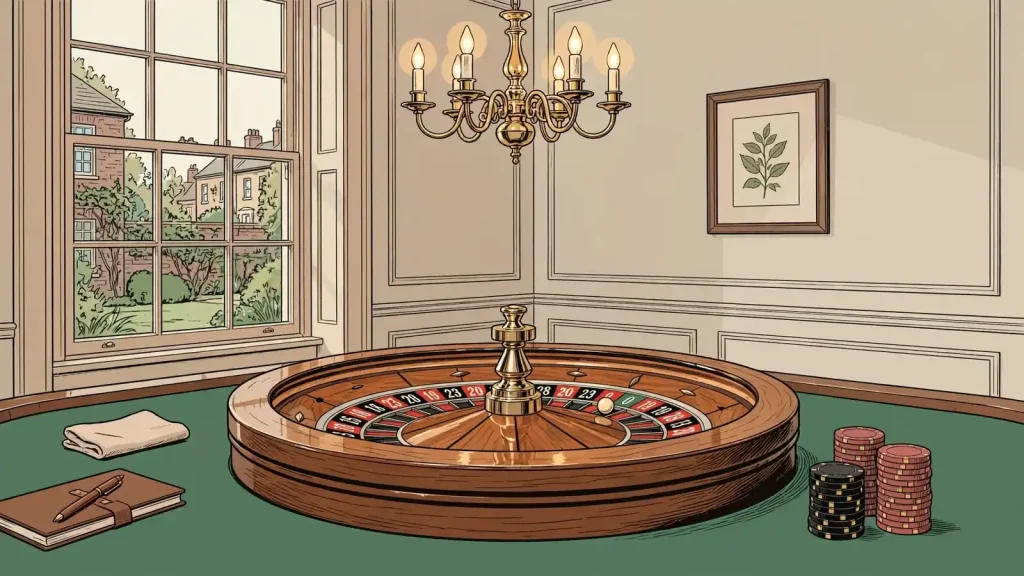
See how the single-zero wheel, bet payouts, game formats and bonus terms shape European roulette in UK casinos.
How European Roulette Works: 37 Pockets and a Single Zero
A European roulette wheel has 37 pockets: one marked zero and 36 numbered from 1 to 36. The ball settles in one pocket at the end of a spin, and that result determines the round. The numbers appear in a particular order around the wheel, but their arrangement does not change the probability of any individual pocket being selected.
The zero is the feature that gives European roulette its defining odds. It is not an additional numbered result within the sequence from 1 to 36; it is a separate pocket. So when you consider a single spin, there are 37 possible outcomes, not 36. Each pocket has the same chance of receiving the ball if the wheel and spin are fair.
How the single zero affects the house edge
The house edge expresses the casino’s mathematical advantage over time. In European roulette, it is 2.70%. This figure follows from the relationship between the wheel’s outcomes and the game’s payouts: the zero creates a result that is not covered by many bets, while the standard payouts are calculated as though the numbered outcomes were the only possibilities.
For a simple illustration of the mechanism, imagine a bet that covers one number. There is one winning pocket among 37, so the probability of a win is 1 in 37. The other 36 outcomes lose. The payout does not fully compensate for the extra possibility introduced by zero; across many spins, that gap produces the house edge.
This is a long-run average, not a charge deducted from each stake or a prediction about the next spin. A player can win or lose in a short session, and results may vary substantially. The edge describes the expected relationship between stakes and returns over repeated play, assuming the game’s rules and payouts remain unchanged. It does not mean that the casino takes a fixed share from every individual wager.
Casino Games: Slots, Live Tables and More
Why the number of pockets matters
The pocket count sets the probability base for the entire game. With 37 possible results, a bet’s chance depends on how many pockets it covers. Covering more pockets increases the chance of a result matching the bet, but the payout is adjusted to reflect that broader coverage. The zero remains relevant because it is one of the possible outcomes even when a bet is based on numbered pockets.
This is why the number of pockets alone is not enough to assess a roulette bet. You also need to know which outcomes it covers and what the game pays if it wins. Those details determine the bet’s individual odds; the wheel’s 37-pocket structure supplies the probabilities behind them.
The wheel and the betting layout are related but not identical. The wheel contains the physical outcomes, while the layout provides places to select numbers or groups of numbers. A number’s position on the layout does not make it more or less likely to appear on the wheel. Nor does a previous result alter the probability of a later spin: each spin is a separate event, and the wheel has no memory of earlier outcomes.
What the house edge does—and does not—tell you
The 2.70% house edge is a property of European roulette’s standard rules, not a measure of how often a particular player will win. It also does not identify a “due” number. If a number has not appeared for several spins, that absence does not increase its chance on the next one. The same 37 pockets remain in play, so each individual pocket retains the same probability on each fair spin.
The edge is useful when comparing the mathematics of games, but it cannot remove uncertainty from a session. Short-term results can fall well above or below the long-run expectation. A streak of wins does not guarantee continued success, just as a run of losses does not make a recovery more likely. No system based on past outcomes can predict where the ball will land.
When you see European roulette offered by an online casino, the key mechanical facts are therefore straightforward: the wheel has 37 pockets, including a single zero, and its standard house edge is 2.70%. These explain the basic probability framework without telling you what any one spin will produce.
Wheel pockets 37
House edge 2.70%
Zero type Single zero
European Roulette Bets and Payouts
A roulette bet is defined by the outcome or group of outcomes you select. The payout states the profit for a winning stake; your original stake is returned as well. The layout offers inside bets on specific numbers or small groups, and outside bets covering broader categories. The stated odds describe a fixed payout, not a prediction that a selection will win.
Inside bets
A straight-up bet covers one number. If the ball lands on that number, the bet pays 35:1. A split covers two adjacent numbers and pays 17:1 if either wins. These bets target narrow outcomes, so a win produces a larger profit relative to the stake than an even-money outside bet.
The payout does not change according to how likely a number feels, how recently it appeared, or how often it has been absent. A selection can be placed again on a later spin, but that does not make its result more predictable.
Outside bets
Outside bets cover broader categories. Red or black, even or odd, and low or high numbers each pay 1:1 when the selected category wins. For instance, a winning red bet returns profit equal to the stake, alongside the returned stake. These options have simpler coverage than a single-number bet, but the payout is correspondingly smaller.
Each spin remains an independent chance outcome. Choosing a category with more possible winning numbers does not make the result certain, and a run of previous results cannot establish what the next spin will be.
| Bet type | What the selection covers | Stated payout |
|---|---|---|
| Straight-up | One number | 35:1 |
| Split | Two adjacent numbers | 17:1 |
| Red or black | One colour category | 1:1 |
| Even or odd | One parity category | 1:1 |
| High or low | One number-range category | 1:1 |
Reading a payout before you bet
Payout ratios are commonly written as profit-to-stake. If a straight-up bet wins, 35:1 means the profit is 35 times the stake; the stake is also returned. A 1:1 win returns profit equal to the stake, plus the stake itself. This distinction helps you compare the displayed payout with the amount you would receive in total.
Before placing a bet, check that the selected area on the table matches the outcome you intend to cover and that the game displays the expected payout. When you play European roulette online, the same bet types and stated payouts apply whether you are trying a free game or staking real money, though the consequences of a loss differ. Do not treat a previous result or a betting system as a way to forecast the next one: roulette outcomes are determined by chance, and no strategy can predict the final result.
Our top casino picks for the UK
- Revery PlayBonus: 100% up to€1,000+ 100 FS · Payout speed: 1-3 business days
- SpinFormulaBonus: 550% Up To £15,000 + 550 FS · Payout speed: 1-3 business days
- BritsinoBonus: Welcome Package – Get your £2,200 + 2,000 FS · Payout speed: 1-3 business days
- ZombillionBonus: Welcome Pack 250% up to £4000 + 200 FS · Payout speed: 1-3 business days
- NightLuckBonus: Welcome Pack + 805% Up To 6400€ + 280 FS · Payout speed: 1-3 business days
- BeOnBetBonus: 100% up to €500 + 100 FS · Payout speed: 1-3 business days
- WinBeastBonus: €5000 + 500 FS + €650 Freebet · Payout speed: 1-3 business days
Reading the Single-Zero Wheel and Table Layout
A European roulette table has two linked parts: the wheel, where the ball settles, and the betting layout, where you select numbers or groups of numbers. The layout is not a picture of the wheel’s physical order. It arranges the numbers for bet selection, while the wheel holds them around its rim. Knowing which part you are looking at helps you read a single-zero game without confusing a wheel pocket with a betting position.
European roulette variants
French roulette uses a single-zero wheel but can offer lower house edges through rules like La Partage or En Prison. American roulette features a double zero, which increases the house edge.
Identifying the wheel
A European wheel has 37 pockets: the numbers 1 to 36 and one green pocket marked 0. On a digital table, the wheel may be shown from above or at an angle; a live stream shows a physical wheel. In either view, the numbered pockets form a ring around the centre. The green zero stands out from the red and black numbered pockets.
The wheel’s sequence is not the same as the number grid on the table. The wheel places pockets around a circular track, while the layout puts numbers into rows and columns so you can choose them. A number’s position next to another pocket on the wheel does not mean the two numbers are neighbours on the betting layout.
This distinction matters when you inspect a European roulette single-zero wheel or a table labelled as single zero. Look for one green pocket marked 0, not a second green pocket marked 00. The label and the visible wheel should agree. The zero is a separate outcome, not a numbered square inserted into the grid of 1 to 36.
The wheel’s colours help you find pockets, but colour alone does not identify every number. Red and black pockets carry numbers; the green pocket carries zero. The number printed on the pocket is the identifying mark. If a display is small, check the number itself rather than relying on colour or on a wheel diagram that may be difficult to read.
Online Casino Tournaments UK: Formats and Rules
Finding your way around the table
On the betting layout, the numbered area is generally a grid with three horizontal rows. The outside betting areas sit around the grid and refer to larger groups of numbers. The zero appears at one end of the numbered section, separated visually from the three rows. The precise screen design can vary, but the key structure remains: individual numbers occupy the central grid, and group choices are placed beside or below it.
A common way to understand the grid is to read it across each row. Each row contains a run of numbers, and the rows together cover 1 to 36. The layout’s arrangement makes it possible to select one number or a position that touches several numbers. The wheel itself does not present numbers in these tidy rows; those rows are an interface for placing a bet.
The zero’s position on screen can make the grid look as though it has an extra space attached to it. That space is not one of the three numbered rows. It corresponds to the green zero pocket on the wheel. Before selecting any area, check whether the marker or chip is placed on zero, on a numbered square, or on a line between squares. Those positions refer to different selections.
Inside areas and outside areas
Inside bets are made on the numbered grid or on its boundaries. A selection placed directly on a number refers to that number alone. A marker placed on the boundary between two adjacent numbers refers to a split; a marker positioned where three numbers meet refers to a street. Other boundary positions can cover larger adjoining groups. The layout’s lines are functional: they show which numbers a position includes.
Table Check
- Confirm the game is labelled European roulette
- Check that the wheel shows a single green zero
- Verify that the table clearly marks inside and outside areas
- Confirm the chip’s position after selecting a bet
Outside bets are printed beyond the numbered grid and cover broader categories. These include red or black, odd or even, low or high, and the columns or dozens shown on the table. They do not point to a single pocket. Instead, each label defines a set of numbered outcomes. The zero sits outside those ordinary numbered groups, so it does not belong to the red or black, odd or even, or low or high categories.
This is a way to read the table, not a prediction method. The labels show the coverage of a selection; they do not indicate which pocket is more likely to appear on the next spin. A clear layout lets you check what a selection includes before confirming it, but it cannot reveal the result in advance.
Reading positions accurately
At a physical table, the dealer’s layout and the position of a chip show the selected area. In an online interface, you may click or tap a square, a line, or a printed group label. A chip or highlighted marker then indicates where the selection has been registered. Do not rely solely on the colour of a chip: read the area under it and confirm that the interface has placed it where intended.
For a number selection, the centre of a square is distinct from its edges. For a split, the marker belongs on the shared edge of two squares. For a street, it sits at the edge covering a row of three. A click near a boundary can be easy to misread on a small display, so inspect the resulting marker before the spin begins. If the interface provides a bet summary, compare that summary with the marked position.
Online Casino Without ID in the UK: What to Know
Outside labels can also be close together. Check the wording and the marked area rather than assuming that a selection belongs to a particular group because of its location. A dozen, a column, and a high-or-low selection cover different sets, even when the controls appear in neighbouring parts of the screen.
What the wheel and layout show together
The wheel tells you the possible pocket outcomes; the layout tells you how a chosen position maps to one or more numbers. On a European roulette table with a single zero, the wheel contains 37 pockets, while the numbered layout covers 1 to 36 and displays zero separately. The table’s colours and labels help categorise numbered outcomes, but they do not turn the layout into a physical map of the wheel.
Before play, check three things: that the game is labelled European roulette, that the wheel shows a single green zero, and that the table marks inside and outside areas clearly. Then confirm the chip’s position after selecting a number or group. This simple visual check helps prevent a common interface mistake: treating a nearby line or label as part of the selection when it refers to a different set of outcomes.
European, American and French Roulette: How the Variants Differ
The key difference in European roulette vs American roulette is the wheel’s pocket count. European roulette has numbers 1 to 36 and one zero. The American wheel adds a double zero, giving it 38 pockets in total. That extra pocket changes the probability of outcomes without changing the number labels shared by both versions.
RNG Roulette
Software-generated outcomes that allow for quick play and often lower minimum stakes.
Live Dealer Roulette
Streamed from a studio featuring a human dealer and a physical wheel.
Speed Roulette
A faster live format that can exceed 150 spins per hour.
On European roulette, the house edge is 2.70%. On the American wheel, the additional double zero increases the disadvantage built into standard bets. This is why the wheel’s layout matters when you choose an online European roulette casino game: the game name alone does not tell you which variant is on offer. Check whether the table shows one green zero or both zero and double zero.
French roulette uses a European-style single-zero wheel, but its rules can reduce the house edge on eligible bets. Under La Partage, if the ball lands on zero, half of an even-money bet is returned rather than the entire stake being lost. The rule changes the result of that particular spin; it does not affect other bet types.
En Prison is another French rule for even-money bets that land on zero. Instead of settling the bet immediately as a loss, the stake is held for the next spin. The eventual result determines whether the held stake is returned or lost. Because La Partage and En Prison soften the effect of zero on even-money bets, French roulette has the lowest house edge among standard roulette variants.
When comparing a European roulette casino game with French or American roulette, distinguish the wheel from the rules applied to it. Pocket count determines the underlying chances; rules such as La Partage and En Prison determine what happens to specific bets when zero appears. Always check the table’s rules before placing a wager, since the variant name alone may not explain how a zero affects your stake.
Online Bingo UK: Tickets, Rooms and Slots
RNG, Live Dealer and Speed Roulette: What Changes Between Formats
The main difference between RNG and live dealer roulette is how each spin is produced. RNG roulette uses software to generate an outcome, so there is no physical wheel or dealer to wait for. Live dealer roulette, by contrast, is streamed from a studio: a human dealer spins a real wheel and releases a physical ball. Both formats present roulette, but the process behind each result and the pace of play differ.
RNG tables can move quickly because the next simulated spin does not depend on a dealer completing a physical sequence. They also tend to have lower minimum stakes; some start at 10p. That can make this format easier to fit around a small playing budget, though a lower stake does not change the chance-driven nature of the results.
At a live European roulette table, you see the wheel and ball drop through a video stream. The dealer’s actions set the pace, and the camera provides a view of the table as the game proceeds. Standard live tables are reported at 80–100 spins per hour. The interval between rounds is part of the format: you are watching a physical process rather than moving straight from one software-generated result to the next.
Speed roulette is a faster live format, not an RNG game. A specialist review reports that it can exceed 150 spins per hour, compared with 80–100 at a standard table. Treat those figures as reported rates rather than a promise about every table; the pace depends on the particular game.
Minimum stakes also vary between live formats. A UK live roulette table may start at 10p, while auto-roulette and speed roulette sometimes have 5p minimums. Auto-roulette automates parts of the process, whereas live dealer games retain a human dealer and physical wheel. Check the displayed table rules and stake limits before joining, since the format name alone does not establish the minimum stake.
Demo Games
A roulette demo allows you to learn the interface and controls without staking real money, though it does not change the underlying chance-driven nature of the game.
Choose by the experience you want: software-generated spins for a quicker, lower-stake option, or a streamed wheel when seeing the physical game matters more. Speed roulette sits between those preferences by retaining a live wheel while reducing the time between rounds.
Roulette Demo Games and Roulette-Themed Slots
A roulette demo lets you try a table game without staking real money. It can show how the interface handles chip placement, bets and spin results, so you can learn the controls before switching to real-money play. Demo availability and the rules displayed can vary by game, so check the table’s help panel rather than assuming every version works the same way.
A demo does not change the underlying game into a prediction tool. The result of each spin remains chance-driven, and practice cannot reveal what a later spin will produce. It can, however, help you understand the layout and see how a particular interface responds when you place or remove a bet.
The word “roulette” also appears in slot titles, but a roulette-themed slot is not a roulette table. A table game has a wheel, a ball and bets placed on the betting layout. A slot uses its own reels, symbols and rules to generate outcomes. The theme may borrow roulette imagery without reproducing its wheel mechanics, betting choices or payouts.
That distinction matters when you see titles such as XXXtreme Lightning Roulette. It is a roulette table game with an added lightning feature, rather than a slot. A specialist review reports that, in this game, a straight-up bet without a lightning multiplier pays 29:1 rather than the standard 35:1; it also reports that outside bets retain standard roulette odds. Check the game’s own rules before playing, because those details concern this specific format.
Live Dream Catcher Casino in the UK: What to Check
Book of Dead is a slot, not a roulette game. Its name belongs in a discussion of slots, but it should not be treated as a roulette demo or as evidence of how a roulette wheel behaves. Likewise, a slot described as three-dimensional, gold or platinum may use those labels to distinguish its presentation or product title; the wording alone does not establish that it follows European roulette rules.
When choosing a European roulette demo, look for an actual roulette table and confirm that its rules identify the single-zero version. For a roulette-themed slot, read the game information separately: it explains the slot’s own features, not table-game odds. Keeping those categories apart prevents a familiar theme or title from being mistaken for the mechanics of roulette.
Roulette Bonuses: Contribution Rates and the 10× Wagering Cap
A bonus wagering requirement sets how much qualifying play must be recorded before bonus funds, or any related winnings, can be withdrawn. Roulette may count towards that requirement, but the game’s weighting is set by the operator’s terms. The amount you stake is therefore not necessarily the amount credited towards wagering.
For instance, at a 10% game weighting, a £10 roulette wager adds £1 to the qualifying total. At 20%, it adds £2; at 100%, the full £10 counts. These examples show how the calculation works, not a recommended stake. The weighting applies to the wager, not to whether it wins: a losing bet can still contribute if the terms say the game qualifies.
Wagering Requirements
Attention Always check the specific terms of a bonus, as roulette may have a lower contribution weighting than other games.
Live and RNG roulette can be treated differently
A specialist review describes UK operators as commonly assigning roulette a 10%–20% weighting, but the applicable rate is the one in the offer’s own terms. The distinction between formats matters. Some terms give live roulette a 10% or 20% weighting while counting RNG roulette at 100%; other terms may exclude a format or apply a different rate. Do not assume that the weighting for a computer-generated game also applies to a streamed table.
No-deposit offers can have separate restrictions. A specialist review reports that some UK operators exclude live roulette from no-deposit wagering and that, where it is included, its weighting can be 0%–10%. If the rate is zero, placing a qualifying-looking bet does not move the wagering total. Check the specific offer before playing, including which roulette format qualifies, what weighting applies and whether any game or maximum-bet restrictions are attached.
The calculation can make roulette a slow way to clear a requirement even when it is permitted. If only a fraction of each wager counts, the qualifying total grows more slowly than the cash wagered. At a 100% weighting, each eligible wager contributes its full stake to the total, but that does not remove any other conditions in the offer. Read the definition of qualifying play alongside the withdrawal rules rather than relying on a headline bonus amount.
What the 10× cap means
Since January 2026, UK regulations limit wagering requirements to a maximum of 10× for all licensed operators. This is a cap on the requirement, not a promise that every offer uses the maximum or that roulette wagers count in full. The offer’s stated multiple can be lower, and its game weighting still determines how quickly eligible play accumulates towards it.
Online Slots Payout Percentage: How RTP Works
Check what the multiple is applied to. An offer may express the requirement by reference to bonus funds or to the bonus and deposit together; those bases produce different totals. Use the wording in the offer to identify the relevant amount, then apply the stated multiple. The 10× ceiling does not settle that calculation for you, and it does not override restrictions on eligible games.
Before accepting, note the wagering base, the maximum multiple, the roulette format allowed, its game weighting and any deadline or other conditions stated in the offer. If a term is unclear, ask the operator to explain it before you opt in. A bonus with a smaller headline value can require less qualifying play, while a higher value can be harder to clear if roulette has low weighting or is excluded. The terms, rather than the label “roulette bonus”, determine what your play will count towards.
Choosing a UK Casino for European Roulette
When comparing European roulette casinos in the UK, separate three questions: whether the operator may legally offer real-money play, whether its roulette catalogue includes the format you want, and whether the account controls and game information are clear enough to assess before depositing. A polished lobby or a prominent European roulette tile does not answer the first question.
Check the operator’s status first
The UK Gambling Commission (UKGC) regulates online gambling in Great Britain. An operator offering real-money gambling to customers in England, Scotland or Wales must hold the relevant UKGC operating licence, wherever the business is based. A casino without a valid UKGC licence cannot legally offer real-money roulette to British residents.
Look up the operator on the UKGC public register and confirm that its licence is current and covers the gambling activity it offers. Check the legal operator’s name, not just the brand displayed on the website: a brand may not match the company name shown in the register. If you cannot establish that the site and the registered licensee correspond, do not deposit.
Do
- Check the operator on the UKGC public register
- Verify the licence covers the specific gambling activity offered
- Confirm the legal operator’s name matches the register
Don’t
- Rely on a brand name alone to determine regulation
- Deposit if you cannot establish a link between the site and the licensee
- Assume a site is regulated just because it claims to be
The licence is not a guarantee that every game or account feature will suit you. It does establish that the operator falls within the British regulatory system, including requirements for customer safeguards and complaints handling. A site’s own claims about being “regulated” are not a substitute for checking its entry on the public register.
Inspect the roulette catalogue and rules
Search the table-game lobby for European roulette specifically. A general roulette category may contain several formats, including live tables, computer-generated games and variants with altered rules. Read the individual game information before opening a table; the title alone may not tell you which rules or paytable apply.
For each table, look for the game provider, whether a real dealer or random number generator runs it, the available stake range and any variant-specific rules. Those details affect what you are selecting, even though they do not make a spin predictable. If you are comparing tables, use the rules and paytable attached to each game rather than assuming that every product labelled “European” is identical.
RTP information should be accessible before you play. Check the game’s information panel, help screen or rules page for the published return figure and confirm that it relates to the exact version offered. If the figure is difficult to locate, ask customer support where it is displayed. Do not treat an unclear or missing explanation as evidence that two tables have the same return.
Assess account safeguards before funding
A UKGC-licensed casino must provide account controls that let you manage play. Before your first deposit, the operator must prompt you to set a financial limit; account-level limit controls must also remain accessible. Look for deposit limits, loss limits, session time reminders, reality checks and cool-off periods, as well as GamStop self-exclusion. These should be identifiable in the account or safer-gambling area, not described only in general promotional language.
Operators must verify your age before allowing you to deposit. Read the account terms to understand what identity checks may be requested and how to contact support if verification is incomplete. UKGC licensees must also provide an internal complaints process and access to an approved Alternative Dispute Resolution service. Locate those routes before you need them; the casino’s terms or help pages should explain how to raise a complaint and what to do if it remains unresolved.
Payment options also matter. Remote gambling operators cannot accept credit-card payments for gambling, including credit-card funding routed through a money service business. They also cannot accept wallet payments where the wallet allows credit-card funds to be used for gambling. Check the payment terms rather than assuming that a familiar wallet is permitted for every funding source.
Compare on evidence, not labels
There is no reliable basis for calling a casino “best” simply because it advertises European roulette or VIP tables. Compare the licence entry, the specific game rules, accessible RTP information, account limits and complaint routes. For VIP roulette, check whether the same safeguards and game information remain available; a higher service tier does not replace them.
A useful shortlist is one where you can verify who operates the site, identify the exact roulette games on offer and find the controls that apply to your account. If any of those checks fails, choose another operator rather than relying on a badge, ranking or promotional claim.