

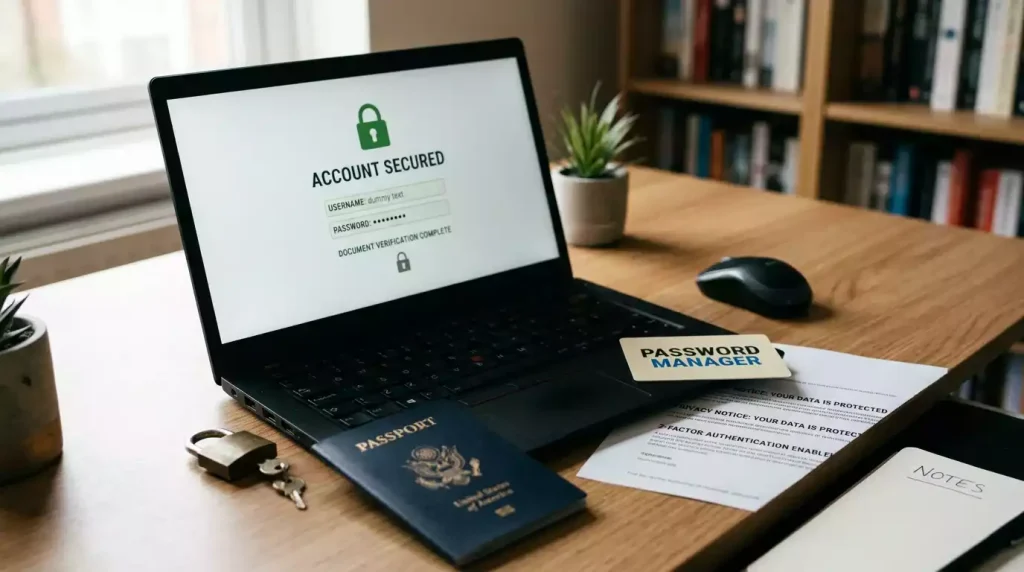
Gambling accounts can involve more personal information than many people expect. A site may ask for your name, date of birth, address, payment details, identity documents, proof of address or information connected with withdrawals. A careful reader should not treat those requests as routine until the basics are clear: who is asking, why the information is needed, how the account is protected, and whether the site explains its privacy position in plain terms.
This guide focuses on practical checks before you share documents or personal data. It is not a technical security audit and it is not legal advice about a specific company. The aim is to help you notice unclear wording, risky account habits and document requests that deserve extra caution. Privacy and security checks are protective steps; they are not a way to avoid lawful identity verification.
The wider picture is in our guide to checks, risks and support.
Why identity and privacy questions matter
For UK-licensed online gambling, age and identity verification are part of the regulated environment. That means a serious business should not be selling “never any checks” as a simple benefit. A request for identification is not automatically suspicious. The risk is different: a reader may share sensitive documents with a site that does not explain who controls the data, what account is being verified, or how the information will be handled. The safer approach is to separate normal verification from vague or pressured document collection.
A clear privacy notice should help you understand what personal information is collected, why it is used, and what broad rights or contact routes are available. The Information Commissioner’s Office explains data use through principles such as lawfulness, fairness and transparency, and the need for a lawful basis. You do not need to become a data-protection specialist to make a practical check. You can still notice whether the privacy wording is findable, whether it names the business, whether it matches the site you are using, and whether the document request is coming through the official account channel.
Risk map: four places to check before sharing
| Area | What can go wrong | Check before sharing |
|---|---|---|
| Account access | A weak password or reused password can expose the account and any stored payment or identity details. | Use a strong unique password, keep devices updated and turn on two-step verification if the account offers it. |
| Document upload | Documents may be requested through unclear channels or with no explanation of what is still needed. | Use the official account area where possible and keep a copy of the request, upload date and response. |
| Payment details | Payment information may be mixed with identity checks, withdrawal delays or unclear customer funds wording. | Read the payment, withdrawal and customer funds sections before depositing more money. |
| Privacy and cookie wording | Vague pages can make it hard to understand who is responsible for the data and why it is used. | Look for clear business identity, contact information and plain explanations rather than copied boilerplate. |
Account security basics that still matter
The National Cyber Security Centre’s everyday advice is relevant here because a gambling account can hold both money-related information and personal documents. Use a strong, separate password that you do not use for email, banking, shopping or other gambling sites. A password manager can help create and store separate passwords. Keep your phone, browser and computer updated, because old software can make ordinary account security weaker.
Two-step verification is useful where it is available. It will not make a questionable site trustworthy, but it can reduce the risk of someone else signing in if your password is exposed. Be cautious with shared devices, saved passwords on public computers, and messages that ask you to “confirm” account information through a link. If a message arrives outside your account, sign in by typing the site address yourself or using a saved bookmark rather than following an unexpected link.
Email security is also part of account security. If your email is compromised, a person may reset gambling account passwords or read document requests. Protect the email account with a strong password and two-step verification as well. This is especially important if the gambling account contains copies of identity documents, withdrawal history or complaint correspondence.
Document-sharing caution
Identity documents should be treated as sensitive. Before uploading anything, check that you understand the request. Is the business asking for proof of age, proof of identity, proof of address, payment ownership, or something else? Is the request linked to a specific account action, such as a withdrawal review? Does the account area show the same request as the email? Is the business name consistent with the official register and the site’s own terms?
Keep a record of exactly what you sent and when. If a document is rejected, ask for the reason in writing rather than sending repeated alternatives blindly. Avoid sending extra documents “just in case”. More data is not always safer. Send what is requested through the official process, keep copies securely, and be careful about forwarding documents to personal email addresses or messaging accounts that are not clearly controlled by the business.
If a site claims that no identification is ever needed, treat that as a warning rather than a convenience. A gambling site may still ask for information later, especially around withdrawals or account reviews. The issue is not whether you personally prefer a check. The issue is whether the business explains its process clearly and handles your information in a way that feels consistent, transparent and accountable.
Privacy notice checks in plain language
- Findability: the privacy notice should be easy to find before you create an account or deposit.
- Business identity: the notice should make clear which business is responsible for the information.
- Purpose: it should explain why personal information is collected, including account operation, verification and legal obligations where relevant.
- Contact route: it should give a realistic way to ask privacy questions or make a data request.
- Consistency: names in the privacy notice, terms and official register should not conflict without explanation.
These checks do not prove that a site is safe, and they do not replace official register checks. They help you notice when something is too vague for the amount of information being requested. If the privacy notice is missing, mismatched or written in a way that hides who is responsible, do not treat that as a small detail. It is a reason to pause before sending documents or payment information.
Red flags before creating or using an account
Be careful with pressure. A message that says your withdrawal will be lost unless you send extra documents immediately through an unusual channel deserves caution. Be careful with “anonymous” language when the account still asks for payment details, address details or identity documents later. Be careful with unclear ownership, copied policy pages, broken privacy links, or terms that talk about different trading names without explaining the relationship.
Also be careful with your own habits. Reusing a password, storing document scans in an unprotected folder, or sending documents from a shared email account can create risks even when the business itself is legitimate. Good privacy practice is not only about judging the site; it is also about reducing the information you expose and keeping your own accounts secure.
How this differs from payment and licence checks
This page is about data, documents and account access. It does not replace a register check, and it does not explain every payment or withdrawal issue. If you are deciding whether the business appears accountable in the UK framework, start with the official register guidance. If your main question is whether to deposit before you understand withdrawals, ID checks and customer funds wording, read the payment and withdrawal guide. Data safety sits alongside those checks. It is one layer of a careful decision, not the whole decision.
Before sharing anything, confirm the business exists on the official register.
Support note
If you are looking for privacy answers because an account is blocked, a withdrawal is delayed, or gambling activity is creating financial pressure, pause before sending more money or documents. Security checks should protect you, not rush you into another deposit. If gambling is affecting your finances, relationships or wellbeing, consider using blocking tools and speaking with a recognised support service. Protecting your accounts and protecting yourself can happen at the same time.