

Payment and withdrawal promises are often the part of a gambling website that feel most practical: how to deposit, how quickly money can come out, and whether documents will be required. They are also where many disputes begin. A careful reader should check the money rules before any deposit, not after an account balance is already locked behind terms they did not read closely.
This page focuses on general checks for UK readers. It does not name operators, compare payment methods, quote fees, promise withdrawal times or suggest ways around identity checks, bank blocks or gambling restrictions. The aim is to help you notice which terms matter before money or documents are at risk.
The wider picture is in our guide to checks, risks and support.
Start with identity expectations
Licensed online gambling businesses must verify age and identity before gambling. Remote operators must verify at least name, address and date of birth before allowing gambling. These requirements matter because claims such as “no checks” or “anonymous play” can be misleading or risky. A site that suggests you can avoid normal verification may not be giving you the full picture about what happens before withdrawal, during a review or after a dispute.
Identity checks are not just a formality. They can affect whether an account can be used, whether funds can be withdrawn and what documents may be requested. Before depositing, read what the site says about verification, document types, timing and account restrictions. If the wording is unclear, do not assume the process will be simple later.
There is also a personal-data angle. A passport, driving licence, bank statement or proof of address is sensitive information. If you would not be comfortable sending those documents to the business after a win, you should not ignore that discomfort before a deposit.
Payment rules that should change your decision
Credit-card gambling by gambling businesses in Great Britain was banned from 14 April 2020, with an exception for non-remote lotteries. That is a clear official rule and should make a reader cautious about any gambling website that appears to promote credit-card gambling as an ordinary route for Great Britain users.
Bank gambling blocks are another important boundary. Some banks offer gambling payment blocks, and their terms can vary, including cooling-off periods in some cases. If a bank block is active, do not look for another payment path. The block is a protection measure. Trying to move around it can turn a protective pause into a larger money problem.
Before using any payment route, ask who receives the payment, what name may appear on statements, what happens if a deposit is rejected, and whether the terms explain withdrawals as clearly as deposits. Deposit pages are often simpler than withdrawal pages. The withdrawal terms are the ones that matter when you want your own money back.
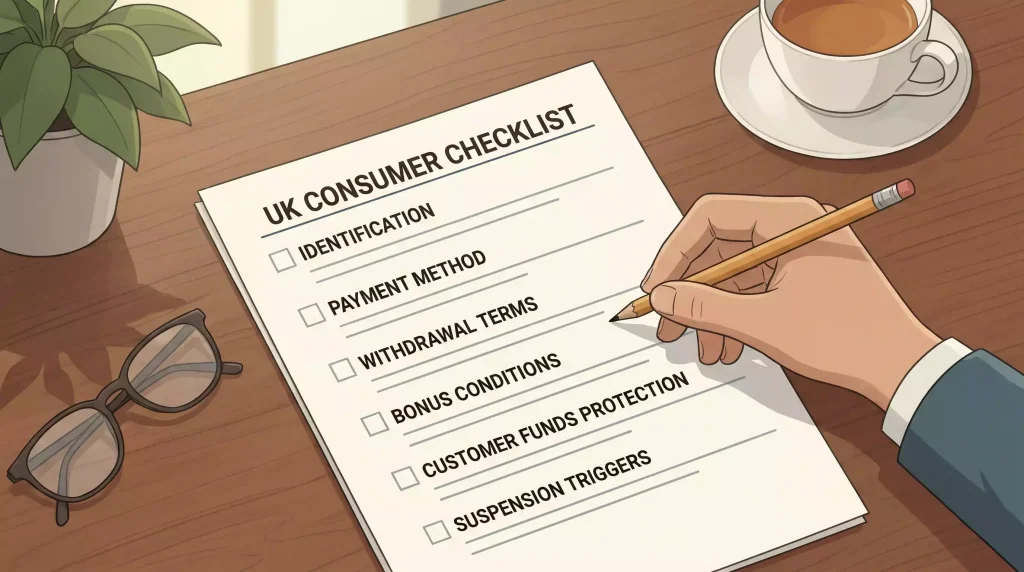
Pre-deposit checklist
| Area | Question to answer before depositing | Warning sign |
|---|---|---|
| Identity | What name, address, date of birth or documents may be checked, and when? | The site heavily promotes “no checks” but has vague later document rules |
| Payment | Which payment rules are explained clearly before money is sent? | The deposit page is clear but withdrawal terms are hard to find |
| Withdrawals | Can you understand when deposit balance can be withdrawn and what may restrict it? | Withdrawal wording is scattered, conditional or only shown after sign-up |
| Bonuses | Are free-bet or bonus conditions clear and prominent? | The promotion is large but restrictions are hidden or difficult to understand |
| Customer funds | Does the site explain the level of customer-funds protection? | Balance protection is implied but not explained in plain terms |
| Protection | Are self-exclusion, limits and bank blocks treated as protective tools? | The site frames protections as obstacles to get around |
This checklist is not about finding a perfect site. It is about avoiding a deposit when important terms are unclear. If you cannot answer these questions from the site’s own terms and official accountability checks, you do not have enough information to make a careful money decision.
Withdrawal terms deserve more attention than deposit speed
Fast-deposit language is easy to understand, but it is not the part that protects you. Withdrawal terms tell you what may happen when you ask for funds to be returned. Official rules require players to be told they can withdraw deposit balance at any time, including when a bonus is pending or active, except where regulatory obligations require restrictions. That makes it important to distinguish deposit balance from bonus funds and from any promotional conditions attached to play.
Operators must treat customers fairly and transparently in their terms and practices. In plain language, you should be able to understand the basic money route before depositing: what counts as your deposit balance, what conditions attach to bonuses, what verification may be required, and what could delay or prevent a withdrawal. If the answer is “you will find out later”, that is not good enough for a cautious reader.
Do not rely on phrases such as “instant payout”, “guaranteed withdrawal” or “no documents needed” without checking the full terms. A promotional promise may not describe what happens when a withdrawal is reviewed, when a bonus is involved, when documents are requested or when account activity is questioned.
Bonuses and free bets: read the restrictions first
Free-bet and bonus advertising should be clear, accurate and should not hide important restrictions. A careful reader should therefore look for the less exciting parts of an offer before considering the headline: wagering requirements, excluded games, maximum conversion rules, time limits, withdrawal restrictions and any link between bonus use and identity checks.
If those conditions are not clear before sign-up, do not assume they will become favourable afterwards. Bonus wording can also distract from the wider checks: who operates the site, how withdrawals work, what happens to deposit balance, and what complaint route exists if the terms are applied in a way you dispute.
A simple rule is useful: if you would not deposit without the bonus, the bonus is influencing your risk decision. Read it more slowly, and consider whether walking away is the safer choice.
Customer funds and insolvency wording
Customer-funds wording is easy to skip because it sounds technical. It matters because there is no general legal duty for gambling operators to protect customer funds if an operator becomes insolvent, although some operators may choose to do so voluntarily. Operators must make customer-funds protection ratings clear. The practical question for a reader is not “will this definitely happen?” but “do I understand what protection is described if something goes wrong with the business?”
If the wording is vague or hard to locate, do not replace it with trust. A clear, plain explanation is part of a safer money review. It still does not guarantee an outcome, but it helps you understand one more risk before money is committed.
When the right next step is to pause
- A bank gambling block is active or you recently set one up.
- You are trying to deposit because of losses, debt, urgency or stress.
- The site promotes easy access while leaving withdrawals and verification unclear.
- You cannot connect the site to an official accountability record you understand.
- You are uncomfortable with the documents or personal information requested.
If any of these points apply, a pause is a practical protection. Read the protection and help guide rather than looking for another route to pay. If a dispute has already happened, keep records and read the complaints and evidence guide. If the concern is about personal documents or account security, continue with the data and account safety guide.
If a payment dispute stalls, follow complaints, evidence and ADR.
A safer way to use this page
Use these checks before any deposit, not as a way to justify one. A clear identity process, understandable withdrawal terms and transparent money wording may reduce confusion, but they do not remove gambling risk. If gambling is linked to debt pressure, chasing losses or conflict at home, money checks are not enough. Help and financial guidance may be the more important next step.
The safest commercial decision is often the least dramatic one: do nothing until the terms make sense, the business identity is clear, and your own protective limits are being respected.